
Meteorite Hunting in Morocco: Why the Sahara Is a Hotspot for Space Rocks
The Moroccan Sahara is usually associated with golden dunes, fossil-rich mountains, vast rocky plains, and some of North Africa’s most spectacular desert landscapes. Yet hidden among the countless stones scattered across these open surfaces are objects that did not form on Earth at all.
They came from space.
Over millions of years, fragments of asteroids, and occasionally pieces of the Moon or Mars, have entered Earth’s atmosphere and reached the ground as meteorites. They fall everywhere on the planet, but finding them is another matter entirely.
Forests hide them beneath vegetation. Oceans swallow them. Wet climates gradually alter them. Agricultural activity can move or destroy them.
The Sahara offers very different conditions.
Its dry climate, limited vegetation, enormous exposed surfaces, and pale desert terrain make meteorite hunting in Morocco particularly interesting. Dark extraterrestrial rocks can sometimes remain visible against lighter ground for long periods, giving experienced hunters a better opportunity to recognize them.
As a result, southern Morocco and the wider Northwest African desert have become internationally important areas for meteorite recovery.
Some meteorites in Morocco are ordinary chondrites containing material almost as old as the Solar System. Others are far rarer. Moroccan desert discoveries have included lunar meteorites and Martian meteorites, including the famous Tissint meteorite that fell in southern Morocco in 2011.
For travelers interested in geology, astronomy, and natural history, this creates an extraordinary connection. Morocco’s rocks can tell the story of ancient oceans and mountain building, while a meteorite lying on the same desert surface may preserve material formed billions of years before those landscapes existed.
So why is the Sahara such a productive place for space rocks? What does meteorite hunting actually involve? How can a possible meteorite be recognized? And why have Morocco meteorites become so important to scientists and collectors around the world?
Why Is the Moroccan Sahara So Good for Finding Meteorites?
Meteorites do not specifically target deserts.
A meteorite has approximately the same chance of falling into an ocean, forest, mountain range, agricultural field, or desert depending on the area involved.
The reason deserts produce so many finds is preservation and visibility.
Dry Conditions Slow Weathering
Many meteorites contain metallic iron and other minerals that react with moisture.
When meteorites land in humid climates, rain, soil water, and vegetation can gradually alter them. Oxidation can destroy metallic material, while chemical weathering changes the minerals preserved inside the rock.
Southern Morocco is extremely dry compared with the Atlantic coast and northern parts of the country.
The Atlas Mountains play an important role in Morocco’s climate. Moisture from the Atlantic is partly blocked by mountain ranges, contributing to increasingly arid conditions toward the southeast.
NASA has highlighted the dry landscapes of Morocco as particularly favorable environments for meteorite preservation. You can explore this climatic contrast through the NASA Earth Observatory overview of wet and dry Morocco.
Dry conditions do not prevent all alteration, but they can allow meteorites to remain recognizable much longer than they might in wetter environments.
The Ground Is Open and Easy to Scan
Vegetation is another important factor.
Imagine trying to find a dark stone several centimeters wide in a dense forest. Fallen leaves, roots, plants, and soil can hide it quickly.
In parts of the Moroccan Sahara, the surface is almost completely exposed.
Hunters can examine large areas of gravel, pale rock, clay, or desert pavement without thick vegetation blocking their view.
This makes visual searching much more effective.
Light Ground Can Highlight Dark Meteorites
Many meteorites develop a dark exterior during their passage through Earth’s atmosphere.
On a pale desert surface, that darker color can make an unusual stone easier to notice.
Experienced hunters are not simply searching for “black rocks,” but contrast is still one of the reasons Saharan terrain can be useful.
The Sahara Is Much More Than Sand Dunes
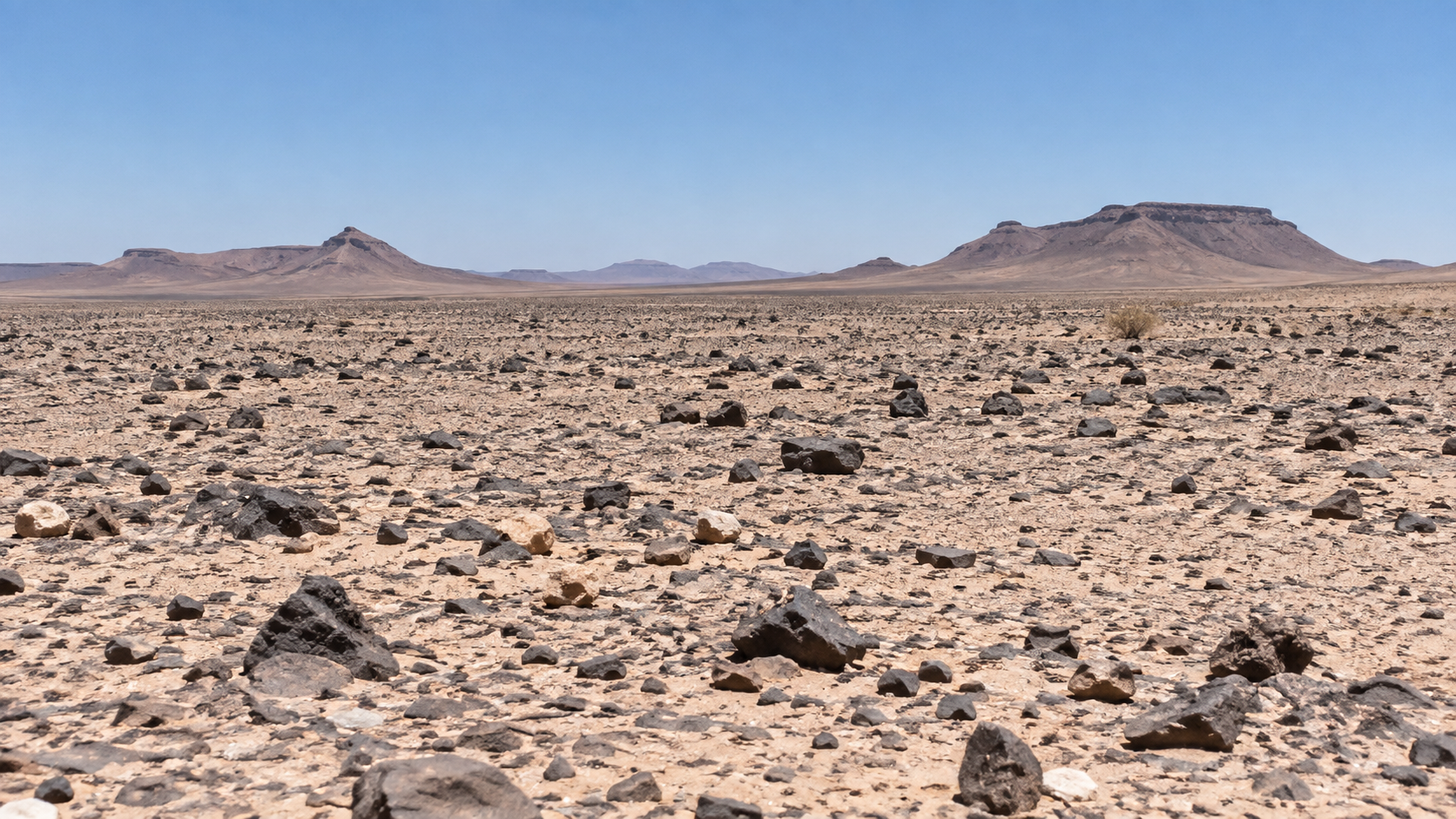
The word Sahara often creates an image of endless dunes.
Morocco certainly has impressive dune fields, including Erg Chebbi near Merzouga, but dunes represent only one type of desert landscape.
Large areas of southeastern Morocco consist of rocky plateaus, gravel plains, hammadas, dry valleys, and exposed geological surfaces.
These environments can be more suitable for meteorite recovery than constantly moving sand.
A meteorite that lands on a dune may quickly become buried. Wind can move enormous quantities of sand, hiding objects for decades before exposing them again.
Stable rocky surfaces behave differently.
Meteorites can remain near the surface, where erosion removes fine particles but leaves larger stones visible.
This is why Sahara meteorite hunting often depends on understanding the landscape rather than simply choosing the most famous desert destination.
Two apparently empty plains can have completely different histories.
One may be frequently flooded.
Another may have remained stable for thousands of years.
Knowing how to read those differences is part of successful field exploration.
Travelers interested in understanding Morocco’s desert geology can explore the country’s fossil beds, rocks, minerals, and desert formations through Atlas Geo Tours’ Geo Tours.
What Is a Meteorite?
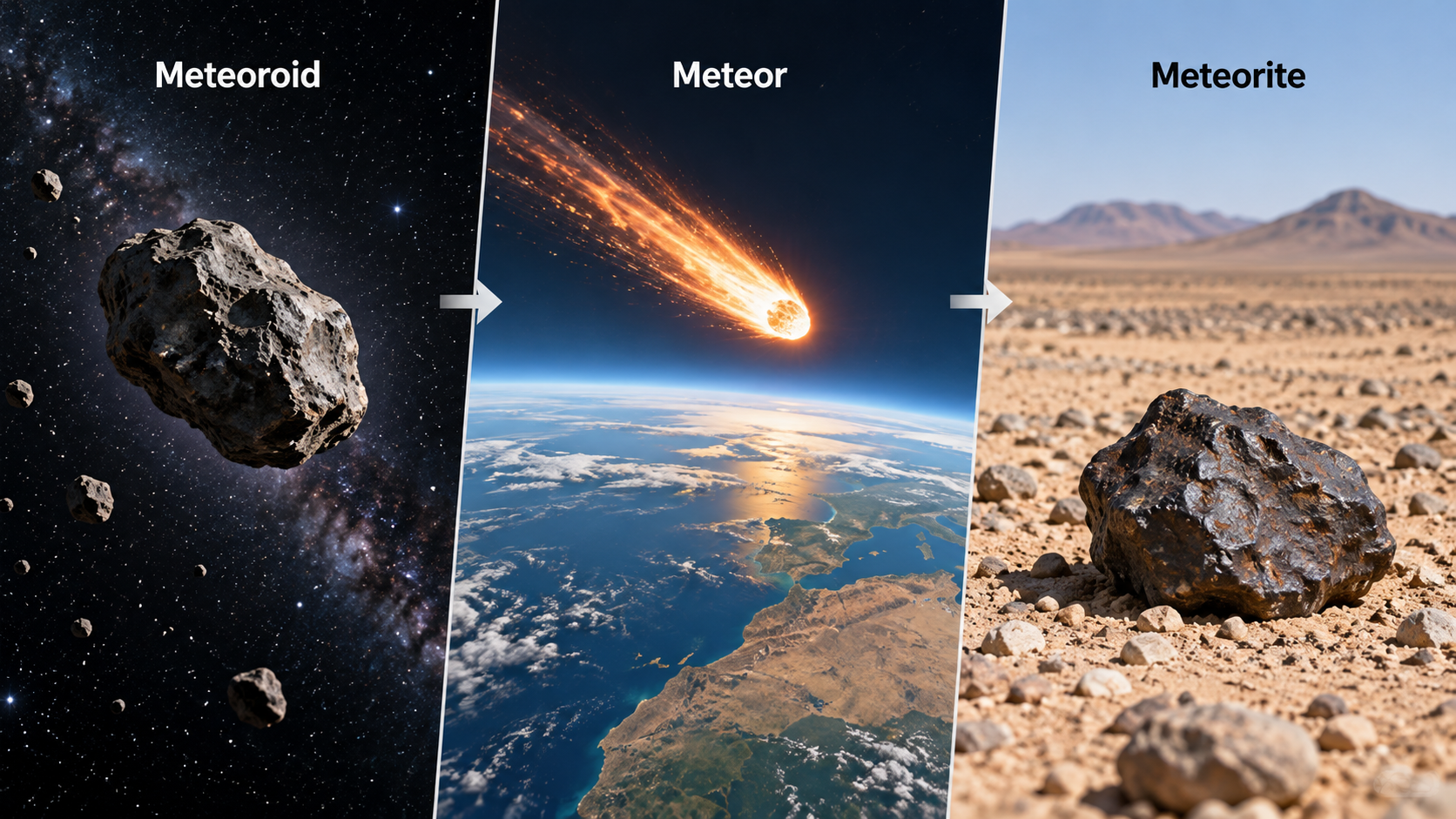
Meteorite terminology can be confusing because three similar words describe different stages of the same object.
Meteoroid
A meteoroid is a natural rocky or metallic object traveling through space.
It can range from a tiny grain to a much larger fragment produced by collisions between asteroids or other planetary bodies.
Meteor
When a meteoroid enters Earth’s atmosphere at high speed, it compresses and heats the surrounding air.
The bright streak visible from the ground is called a meteor.
This is what people commonly call a shooting star.
Meteorite
If part of the object survives atmospheric entry and reaches Earth’s surface, the surviving material is called a meteorite.
Some incoming objects break into many pieces before reaching the ground.
These fragments can scatter across an elongated region known as a strewnfield.
Where Do Meteorites in Morocco Come From?
Most meteorites recovered on Earth come from asteroids.
The asteroid belt between Mars and Jupiter contains countless rocky bodies left over from the early history of the Solar System.
Collisions between these objects can break off fragments and send them into new orbits.
Over very long periods, gravitational interactions can push some fragments onto paths that eventually cross Earth’s orbit.
But asteroid meteorites are not the only objects found in Northwest Africa.
The Main Types of Morocco Meteorites
Meteorites are classified according to their composition, mineralogy, texture, and history.
Ordinary Chondrites
Ordinary chondrites are among the most common meteorites recovered worldwide and also make up many Saharan finds.
They are stony meteorites containing silicate minerals and small amounts of metallic iron and nickel.
Many preserve tiny rounded structures called chondrules.
These formed during the earliest stages of the Solar System, making chondrites some of the oldest accessible material scientists can study.
Holding one is very different from holding an ordinary terrestrial rock.
The material may have formed around 4.5 billion years ago, before Earth became the planet we know today.
Achondrites
Achondrites come from parent bodies that experienced more complex geological processes.
Their source objects became hot enough for melting and differentiation to occur.
As a result, some achondrites can look surprisingly similar to igneous rocks formed on Earth.
This is one reason appearance alone is not enough for reliable meteorite classification.
Iron Meteorites
Iron meteorites contain large quantities of iron and nickel.
They are usually much denser than ordinary terrestrial stones.
Many scientists interpret them as fragments from the metallic interiors of ancient differentiated asteroids that were later destroyed by collisions.
Stony-Iron Meteorites
These contain significant amounts of both silicate minerals and metal.
Some are visually spectacular when cut, particularly pallasites, where crystals can appear surrounded by metallic material.
Lunar Meteorites
A powerful impact on the Moon can launch fragments of lunar rock into space.
Some eventually reach Earth.
Northwest African deserts have produced important lunar meteorites, providing planetary scientists with natural samples of the Moon.
Martian Meteorites
Mars can lose rock in the same way.
Large impacts can eject pieces of the Martian crust with enough speed to escape the planet’s gravity.
A tiny proportion of those fragments eventually reach Earth.
One of the most famous examples fell directly in Morocco.
Tissint: The Meteorite From Mars That Fell in Morocco
On the night of July 18, 2011, people in southern Morocco observed a bright fireball crossing the sky near the region east of Tata.
Fragments were later found in the desert.
Scientists eventually confirmed something extraordinary.
The meteorite came from Mars.
The specimen became known as Tissint, after the region near where material was recovered.
Tissint is classified as a Martian shergottite.
Its scientific importance is especially high because the fall was observed and meteorite fragments were collected relatively soon afterward.
Fresh meteorites are valuable because they have experienced less contamination and weathering on Earth.
Scientists can therefore examine minerals, gases, and microscopic structures that may preserve information about geological processes on Mars.
Tissint turned an isolated part of the Moroccan desert into a location of global planetary significance.
For anyone fascinated by Morocco space rocks, it is perhaps the clearest reminder that objects from another planet can genuinely end their journey on Moroccan soil.
What Does “Northwest Africa Meteorite” Mean?
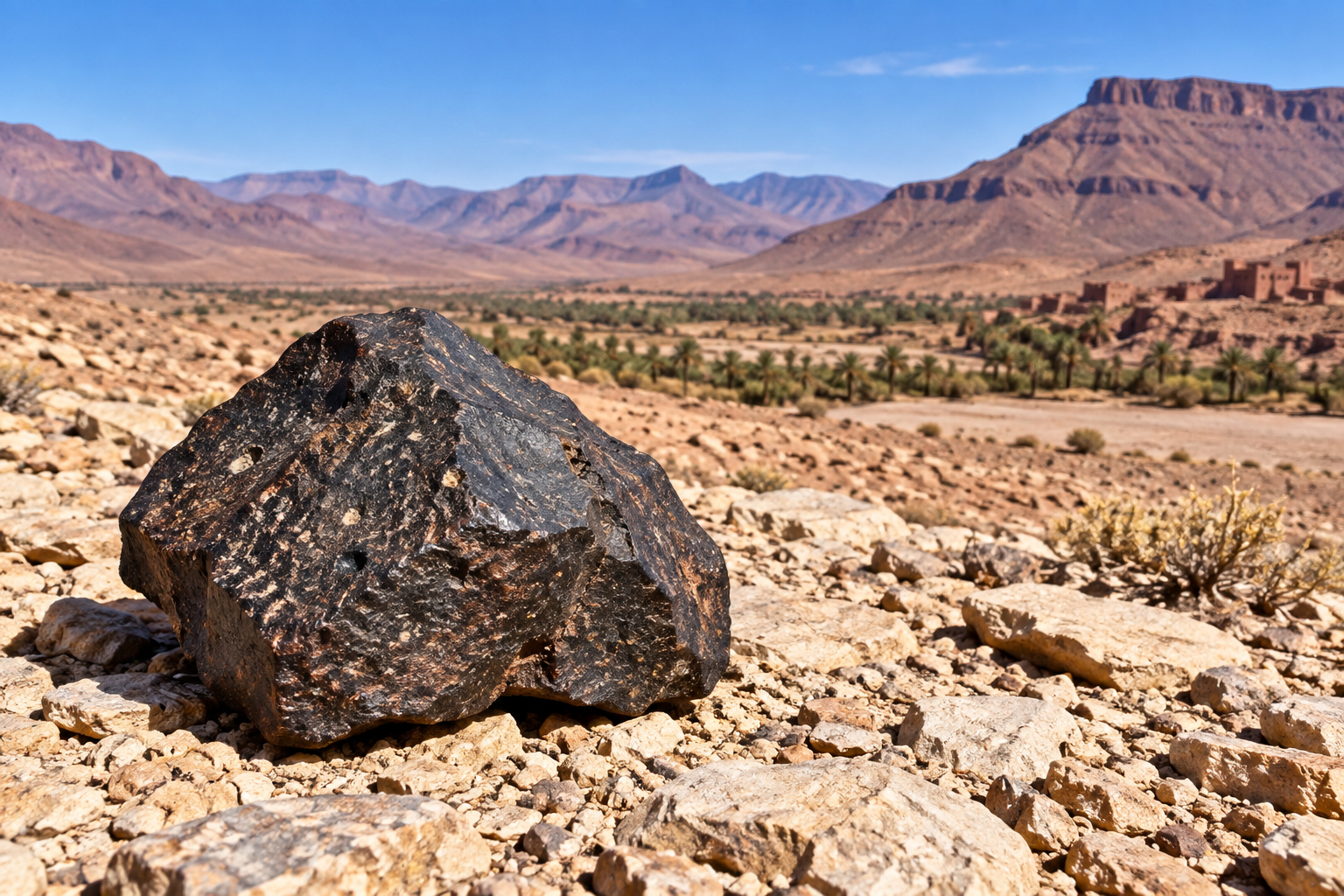
Anyone researching meteorites will quickly encounter specimens with names beginning with NWA, followed by a number.
NWA means Northwest Africa.
Historically, many meteorites from Morocco and surrounding Saharan regions entered scientific or collector networks without precise documented recovery coordinates.
When a specimen could not be named after a verified local geographic location, it could receive an NWA classification number instead.
This produced names such as NWA 7034, NWA 11788, and thousands of others.
The system is practical, but it also demonstrates why documentation matters.
The location where a meteorite is found can help scientists understand:
- how long it may have remained on Earth
- how fragments are distributed
- whether several specimens belong to the same fall
- how desert environments preserve extraterrestrial material
Precise recovery information can therefore be almost as important as the specimen itself.
How Do Meteorite Hunters Search in Morocco?
Finding a meteorite is not simply a matter of walking into the Sahara and picking up the darkest rock.
Most stones that look unusual are still terrestrial.
Experienced hunters learn to understand both meteorites and local geology.
First, Learn the Normal Rocks
One of the most valuable skills is recognizing what normally belongs in a landscape.
Suppose a desert surface is dominated by pale limestone.
A dense, dark stone containing metallic material may immediately deserve attention.
In another region, dark volcanic rocks may be common. There, color becomes much less useful.
Understanding local geology helps hunters recognize anomalies.
Search Stable Surfaces
Meteorites are easier to find where the ground has remained relatively stable.
Areas affected by regular flooding, heavy sediment deposition, or constantly moving sand can bury and transport stones.
Stable desert pavements are often more promising.
Walk Slowly
Searching on foot makes it possible to inspect small objects carefully.
Driving can cover much greater distances but makes small specimens easy to miss.
Experienced hunters may combine both approaches by using vehicles to reach remote areas and then searching promising surfaces on foot.
Document Possible Finds
A potential meteorite should be documented before being removed.
Useful information can include:
- exact location
- photographs
- surrounding surface
- orientation
- nearby fragments
- date of discovery
Good documentation preserves valuable context.
How Can You Recognize a Possible Meteorite?
No single visual feature proves that a rock came from space.
However, several characteristics can make a specimen worth investigating.
Fusion Crust
During atmospheric entry, the outside of a meteorite can melt.
When the object reaches the ground, it may have a thin dark coating known as a fusion crust.
Fresh fusion crust can be striking, but desert weathering gradually changes its appearance.
Magnetic Attraction
Many meteorites contain metallic iron.
For this reason, a magnet may be attracted to them.
However, many terrestrial rocks are also magnetic.
This test can support identification but cannot confirm it.
Unusual Density
Meteorites containing metal can feel surprisingly heavy for their size.
Iron meteorites are especially dense.
Regmaglypts
Some meteorites develop shallow depressions on their surface known as regmaglypts.
They can resemble marks made by pressing a thumb into soft clay.
No Large Gas Bubbles
Meteorites generally do not have the strongly bubbly appearance found in some volcanic rocks and industrial slag.
Industrial material is one of the most common meteorite look-alikes.
Discover Morocco’s Geological Treasures
Explore the Sahara, fossils, minerals, and unique geological landscapes with an expert-led journey.
Why Laboratory Analysis Is Important
Even experienced hunters can be fooled by terrestrial rocks.
A reliable meteorite classification may require:
- microscopic examination
- mineral identification
- chemical analysis
- metal composition
- oxygen isotope analysis
- comparison with recognized meteorite groups
Rare meteorites, especially possible lunar or Martian specimens, require particularly careful scientific analysis.
A rock should never be called a Martian meteorite simply because it looks unusual.
Scientific classification is what transforms an interesting stone into a recognized meteorite specimen.
Meteorite Hunting and Fossil Hunting Are Different
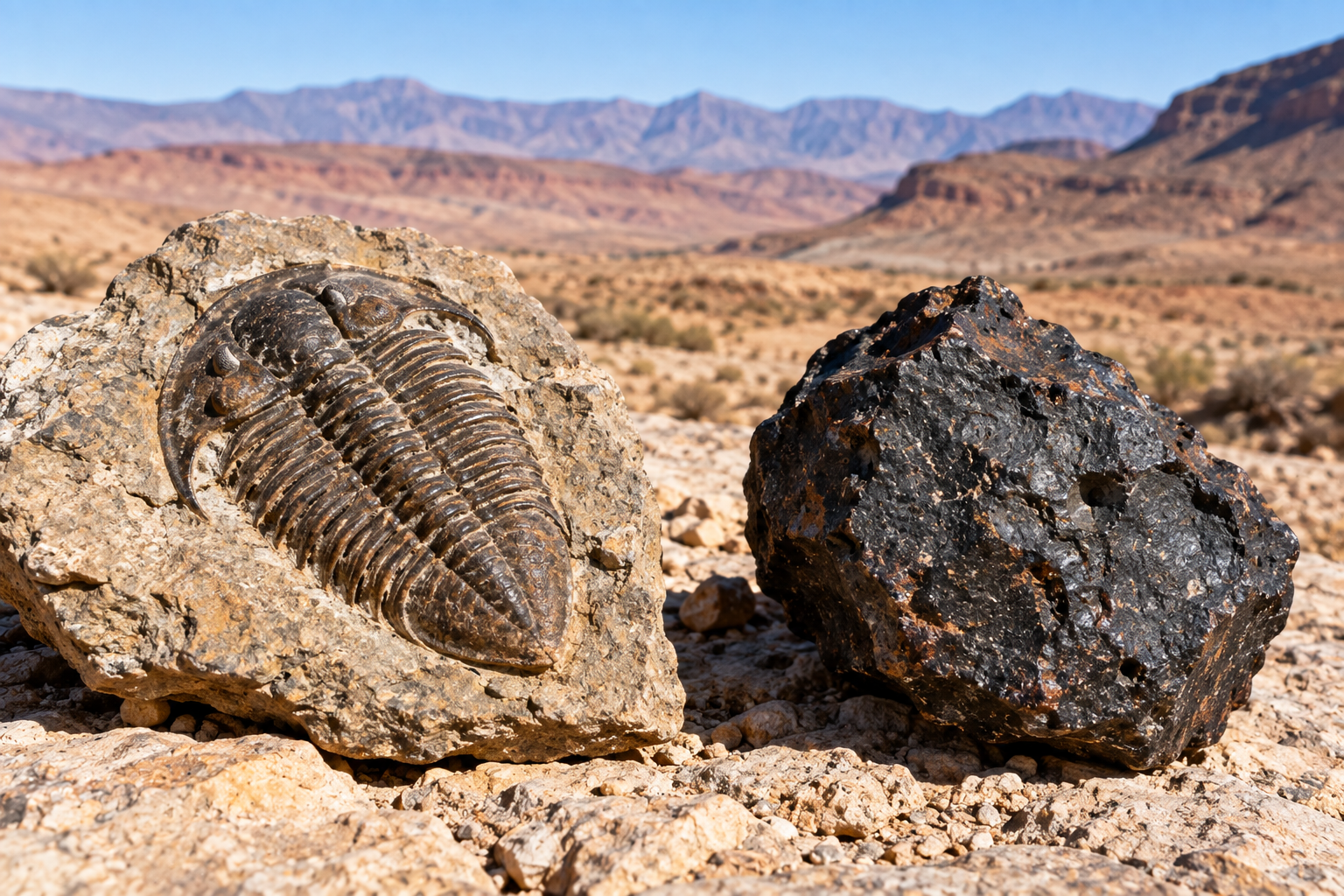
Morocco is famous for both meteorites and fossils.
The two subjects often attract the same travelers, but their geological context is completely different.
Fossils belong to the rock formations in which they formed.
A trilobite around Alnif, for example, comes from sediment deposited in an ancient marine environment. Understanding the age and type of rock tells fossil hunters where to search.
Meteorites do not share that relationship with the rocks beneath them.
They arrived later from space.
A meteorite resting on Devonian limestone may have fallen only thousands of years ago.
The limestone tells one story.
The meteorite tells another.
Readers interested in Morocco’s ancient marine life can discover more in Atlas Geo Tours’ beginner’s guide to Morocco’s fossils.
This contrast makes southern Morocco fascinating for Earth science.
Fossils reveal the evolution of life on our planet.
Meteorites reveal the material from which planets themselves formed.
Why Local Knowledge Is Essential
The large number of meteorites in Moroccan Sahara is not explained by climate alone.
Local knowledge has played an enormous role.
Experienced Moroccan meteorite hunters have spent years learning how to read desert terrain.
They recognize unusual rocks, understand vehicle routes, know where stable surfaces occur, and can work in environments that may appear completely featureless to visitors.
This experience is especially important in remote regions.
The Sahara can involve:
- extreme temperatures
- limited water
- weak or absent mobile coverage
- difficult tracks
- large distances between settlements
- rapidly changing weather
- terrain that is difficult to navigate
Visitors should never treat remote meteorite searching like a casual walk beside a hotel.
Traveling with experienced local support makes exploration safer and also provides a much deeper understanding of the landscape.
Atlas Geo Tours follows the same field-based approach during its geological tours in Morocco, where fossil, mineral, and geological sites are explored with knowledge of the terrain and local context.
Meteorites Are Part of Morocco’s Geological Heritage
Meteorites can have commercial value, particularly when they are rare.
But their importance goes beyond money.
A meteorite may preserve information about the formation of the Solar System, asteroid evolution, the Moon, or Mars.
Its recovery location can also be scientifically important.
For this reason, visitors should approach meteorites as part of Morocco’s geological heritage rather than simply as souvenirs.
Collection, ownership, and export can be subject to Moroccan regulations.
Anyone planning to purchase, collect, or export meteorite material should verify current legal requirements and ensure that specimens have appropriate documentation.
A scientific overview of Morocco’s meteorite heritage and regulatory environment is available through the journal Meteoritics & Planetary Science.
Responsible meteorite exploration means respecting:
- local regulations
- land access
- scientific documentation
- protected areas
- important discovery sites
- Moroccan geological heritage
Meteorites Connect Geology With Astronomy
Few subjects bring geology and astronomy together as naturally as meteorites.
They are physical pieces of astronomical bodies that geologists can hold, examine, classify, and study.
During the day in southern Morocco, travelers can explore ancient terrestrial rocks.
At night, the same desert offers views of the celestial objects and processes connected with the origin of meteorites.
This is why meteorites fit so naturally into the philosophy of Atlas Geo Tours.
The company’s astronomy and geology field trip combines geological exploration during the day with observations of the night sky.
A traveler may spend the afternoon examining sedimentary rocks containing fossils hundreds of millions of years old.
After sunset, they can observe planets, stars, and deep-sky objects.
Meteorites connect those two experiences.
They are stones from the sky lying directly on Earth’s surface.
Exploring the Sahara After Dark
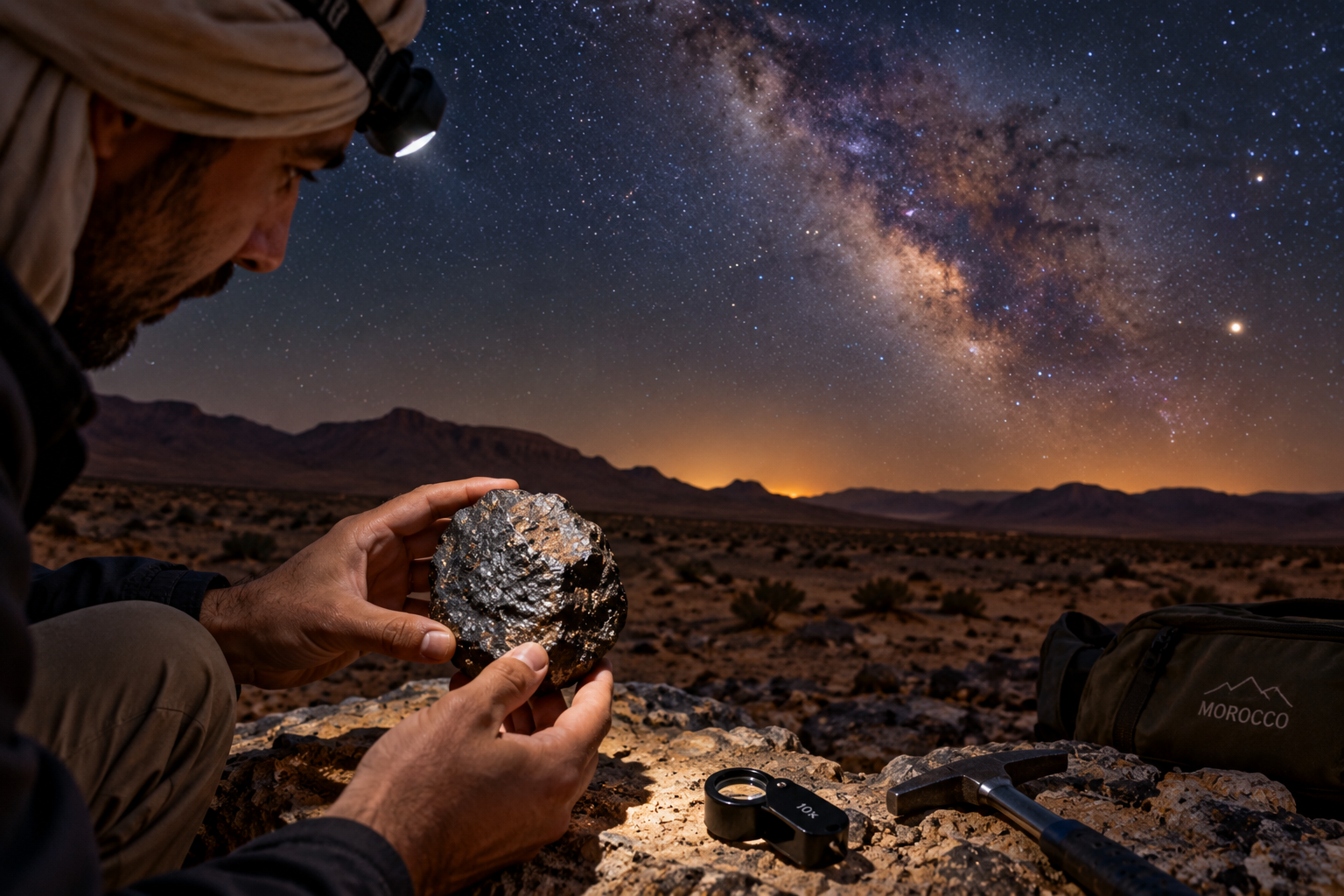
The relationship between meteorites and astronomy becomes even more powerful after sunset.
Far from large cities, southern Morocco can provide dark skies with limited artificial light.
Visitors can observe constellations, planets, the Milky Way, and seasonal astronomical events.
Atlas Geo Tours’ stargazing tours in Morocco allow travelers to explore this night-sky dimension through guided observation.
The desert then becomes a place where two stories meet.
One story is written in the ground.
The other is written across the sky.
A rock collected from Earth’s crust can reveal geological processes that occurred millions of years ago.
A meteorite may contain material formed when the Solar System itself was young.
Above both of them is the universe from which that extraterrestrial stone arrived.
A Different Way to Discover Morocco
Many people visit the Moroccan Sahara for dunes, camel journeys, desert camps, and sunsets.
Those experiences are part of the region’s attraction, but the desert has another side.
It is also a natural scientific landscape.
Its exposed rocks reveal ancient environments.
Its fossil beds preserve organisms from prehistoric oceans.
Its minerals record complex geological processes.
Its dark skies open a window onto the universe.
And occasionally, its surface preserves stones that fell from space.
Travelers who already know Morocco for its fossils can explore the country’s paleontological heritage in Atlas Geo Tours’ guide to fossil hunting in Morocco.
Meteorites add a completely different scale to the experience.
Instead of asking what lived here millions of years ago, they invite another question:
Where in the Solar System did this stone begin its journey?
That question is one of the reasons meteorite hunting in Morocco continues to fascinate scientists, collectors, and travelers.
The Moroccan Sahara is not special because space rocks fall there more often than elsewhere. It is special because the landscape gives us an unusually good opportunity to find what has already fallen.
Dry climate helps preserve specimens.
Open terrain makes searching possible.
Stable desert surfaces can keep them exposed.
Experienced local hunters know how to recognize what does not belong.
Together, those conditions have transformed parts of southern Morocco into one of the world’s most fascinating natural laboratories for meteorite discovery.
A small dark stone on a desert plain may seem insignificant.
But its history could begin before the Sahara existed, before the Atlas Mountains rose, and even before Earth became a fully formed planet.
That possibility makes every genuine meteorite far more than just another rock.
It is a piece of the Solar System waiting on the surface of Morocco.
Frequently Asked Questions About Meteorite Hunting in Morocco
Why are so many meteorites found in Morocco?
The Moroccan Sahara combines dry conditions, limited vegetation, large exposed surfaces, and relatively stable desert terrain. These conditions help preserve meteorites and make them easier to find than in wetter or densely vegetated environments.
Is Morocco a good place for meteorite hunting?
Yes. Morocco and the wider Northwest African Sahara are internationally important meteorite recovery areas. Many scientifically significant specimens have been discovered in the region.
Do more meteorites fall in the Sahara?
Not necessarily. Meteorites fall around the world. The Sahara is exceptional because the dry, exposed landscape makes fallen meteorites easier to preserve and recover.
Where are meteorites found in Morocco?
Most discoveries are associated with southern and southeastern desert regions. Exact recovery locations vary, and many specimens historically received Northwest Africa designations when precise coordinates were unavailable.
What does NWA mean on a meteorite?
NWA means Northwest Africa. Meteorites given NWA numbers were recovered somewhere in the region but did not receive a conventional geographic name based on a precisely documented locality.
What is the most famous meteorite from Morocco?
Tissint is one of the most famous. It fell in southern Morocco on July 18, 2011 and was scientifically identified as a Martian meteorite.
Are Martian meteorites really found in Morocco?
Yes. Tissint is a confirmed example. Other Martian meteorites have also been recovered from Northwest Africa.
Can meteorites from the Moon be found in Morocco?
Yes. Lunar meteorites have been recovered in Northwest Africa. Their origin is established through detailed laboratory analysis rather than appearance alone.
How can I tell if a rock is a meteorite?
Possible signs include a fusion crust, high density, magnetic attraction, and certain surface textures. However, many terrestrial rocks resemble meteorites, so scientific analysis is often necessary for confirmation.
Are meteorites always magnetic?
No. Many meteorites contain enough metallic iron to react to magnets, but magnetic response varies by meteorite type. Magnetism alone cannot prove that a specimen is extraterrestrial.
Can tourists keep meteorites found in Morocco?
Meteorite collection and export may be regulated. Visitors should verify current Moroccan rules and documentation requirements rather than assuming that a meteorite can automatically be collected or taken abroad.
Can meteorite hunting be combined with a geology tour?
Yes. Southern Morocco offers fossil beds, mineral sites, desert geology, and meteorite recovery landscapes. These subjects can complement one another during a geology-focused journey.
Can meteorite hunting be combined with stargazing?
Yes. Meteorites create a natural connection between geology and astronomy. The same Saharan landscapes explored during the day can offer excellent opportunities for stargazing and telescope observation after sunset.