Prehistoric Rock Art in Morocco:Hidden Engravings Across the Atlas and
Morocco’s mountains and desert landscapes preserve stories that began thousands of years before modern cities, roads, and borders appeared.
Some of these stories are written in fossils and geological formations. Others were deliberately carved into stone by people who lived, traveled, hunted, raised animals, and crossed the landscapes of prehistoric North Africa.
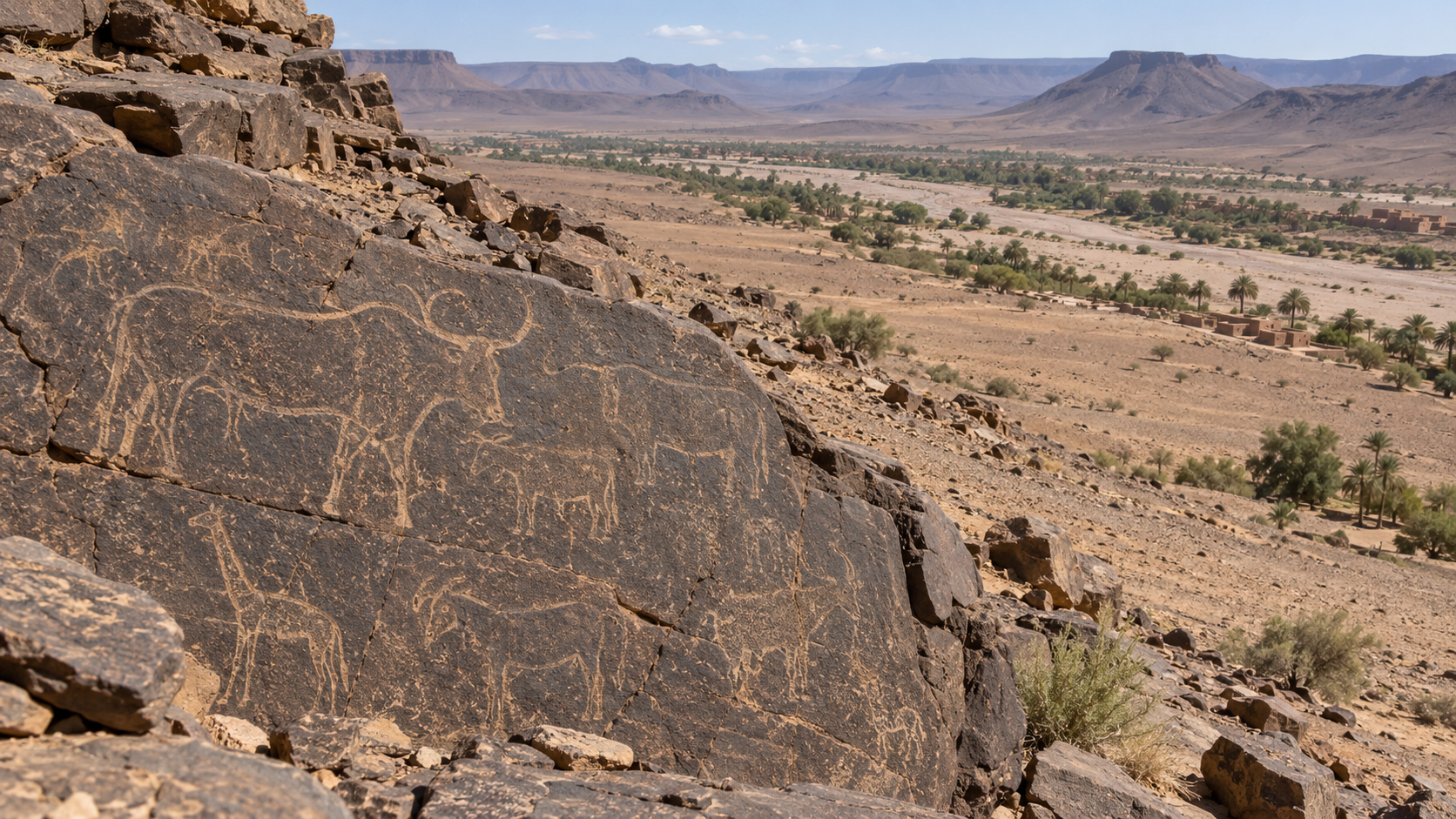
Across the High Atlas and the regions south of the mountains, prehistoric rock art in Morocco can be found on exposed slabs, rocky plateaus, cliffs, and isolated desert outcrops. Some engravings depict cattle and wild animals. Others show human figures, horses, camels, weapons, geometric symbols, and mysterious shapes whose meanings are still debated.
The best-known Morocco rock art sites include Oukaïmeden and the Yagour Plateau in the High Atlas, as well as numerous locations throughout the Draa Valley and the pre-Saharan south.
Together, these engravings provide an unusual window into changing environments and human societies.
Images of elephants, rhinoceroses, cattle, and other animals remind us that North Africa did not always look the way it does today. Weapons and human figures offer clues about social life. Horse and camel scenes reveal later changes in transport and movement across the region.
Yet rock art is not a simple historical record. Many engravings are difficult to date precisely, and their original meanings may never be fully known.
That mystery is part of what makes Morocco petroglyphs so fascinating.
To stand in front of an engraving in the Atlas Mountains or on a remote Saharan rock surface is to encounter a message created by someone from another time, even when we can no longer understand exactly what they wanted to say.
What Is Prehistoric Rock Art?
Rock art is a general term for images created directly on natural rock surfaces.
It can take several forms.
Rock Engravings
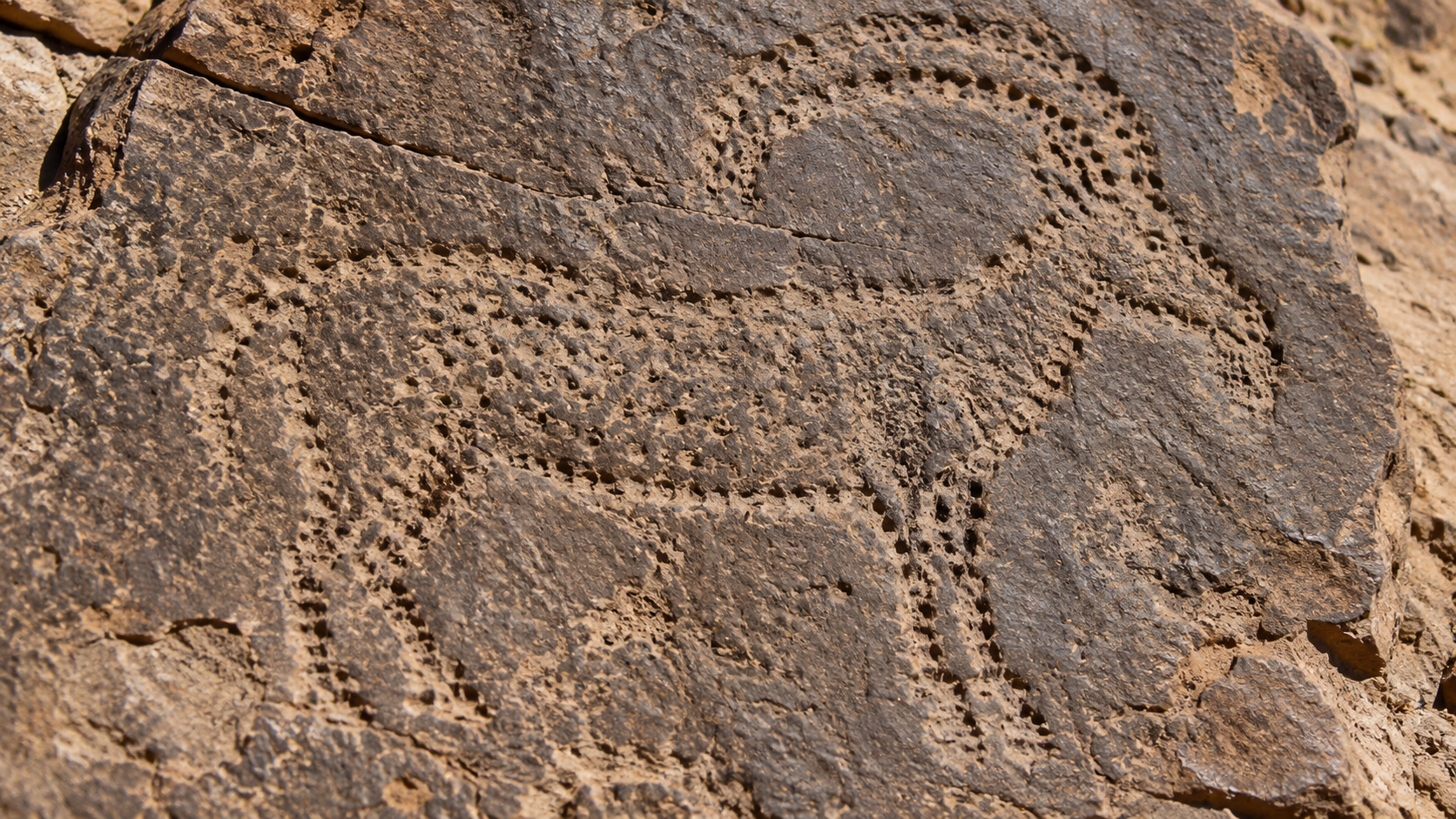
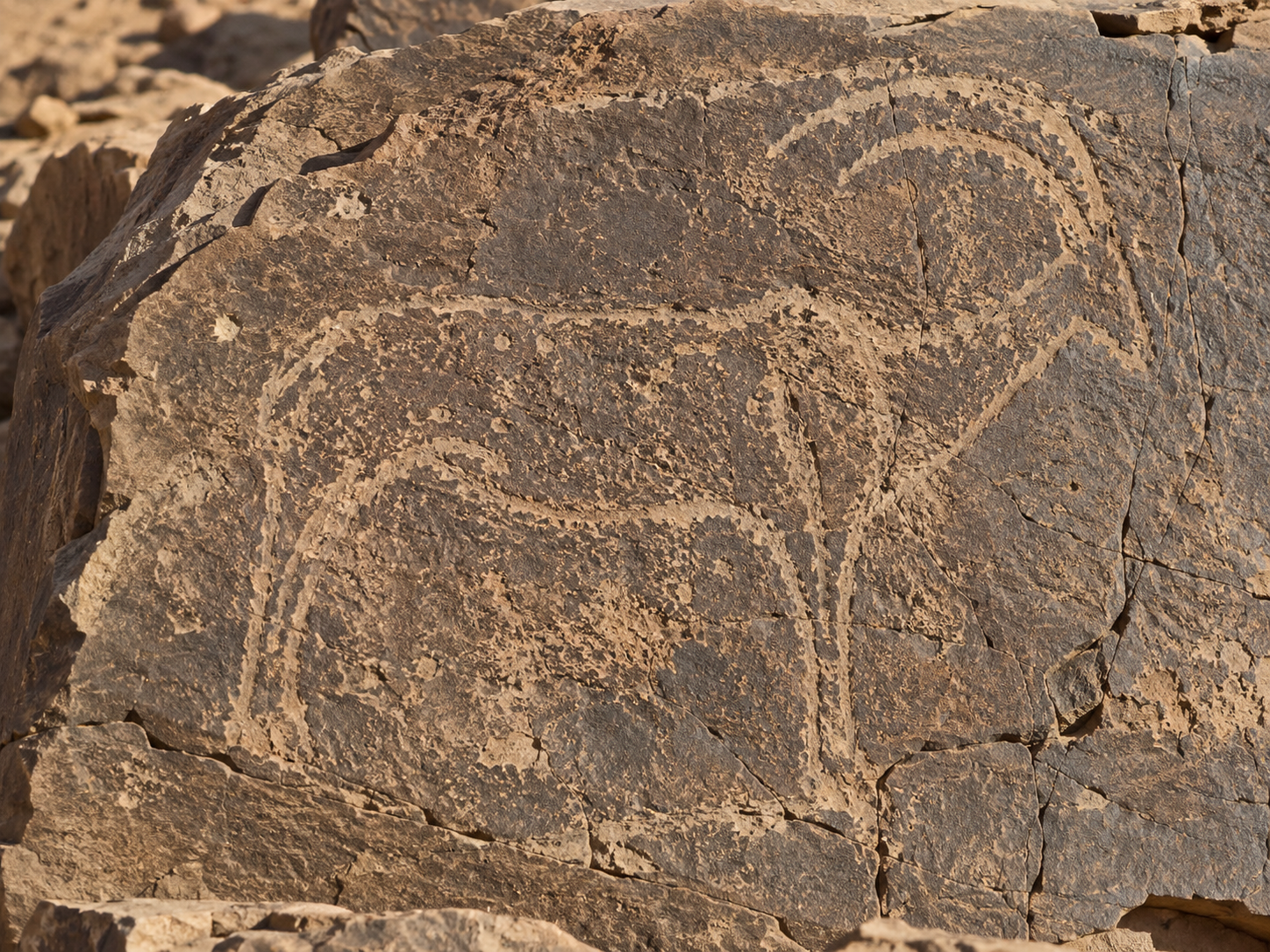
Most Moroccan rock art consists of engravings, also called petroglyphs.
The image was created by removing or modifying part of the rock surface. Ancient artists could use techniques such as pecking, incising, grinding, or polishing.
The result can range from a simple outline to a deeply worked animal, weapon, or human figure.
Engravings are especially well suited to Morocco’s exposed rocky landscapes because they can survive for extremely long periods.
Rock Paintings
Painted rock art also exists in North Africa, but it is much less common in Morocco than engraved art.
Paintings generally require more protected environments, such as caves or rock shelters, because exposed pigments are vulnerable to rain, sunlight, wind, and erosion.
This is one reason travelers exploring Morocco are much more likely to encounter engraved stone surfaces than prehistoric paintings.
Petroglyphs
The word petroglyph specifically describes an image carved, pecked, or engraved into rock.
Therefore, many of the famous rock carvings Morocco preserves can also be described as Moroccan petroglyphs.
Where Can Rock Art Be Found in Morocco?
Rock art is not evenly distributed across the country.
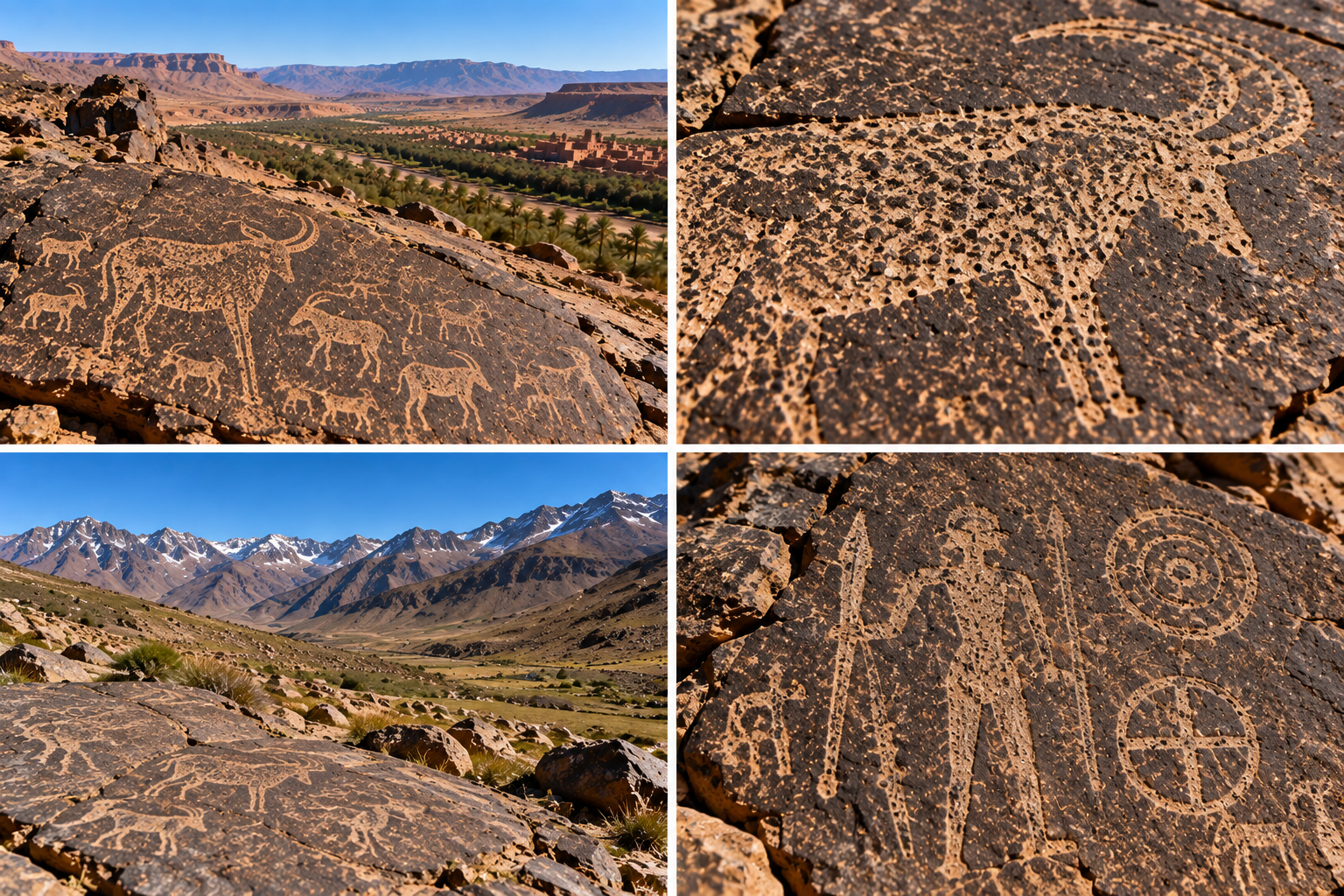
Two broad regions are especially important: the High Atlas Mountains and the large arid zone extending east and south of the Atlas toward the Sahara.
According to the British Museum’s African Rock Art project, major concentrations occur around Oukaïmeden, Yagour, and Jbel Rat in the High Atlas, while many additional sites are distributed throughout southern Morocco. The museum’s overview of rock art in Morocco provides an excellent introduction to this heritage.
The geography itself is important.
Rock art required suitable stone surfaces, but people also had reasons to visit particular places.
High mountain pastures, valleys, water sources, migration routes, and desert corridors could all bring communities repeatedly into the same landscape.
Over generations, some places accumulated many different engravings.
Oukaïmeden Rock Art: A Hidden Treasure in the High Atlas
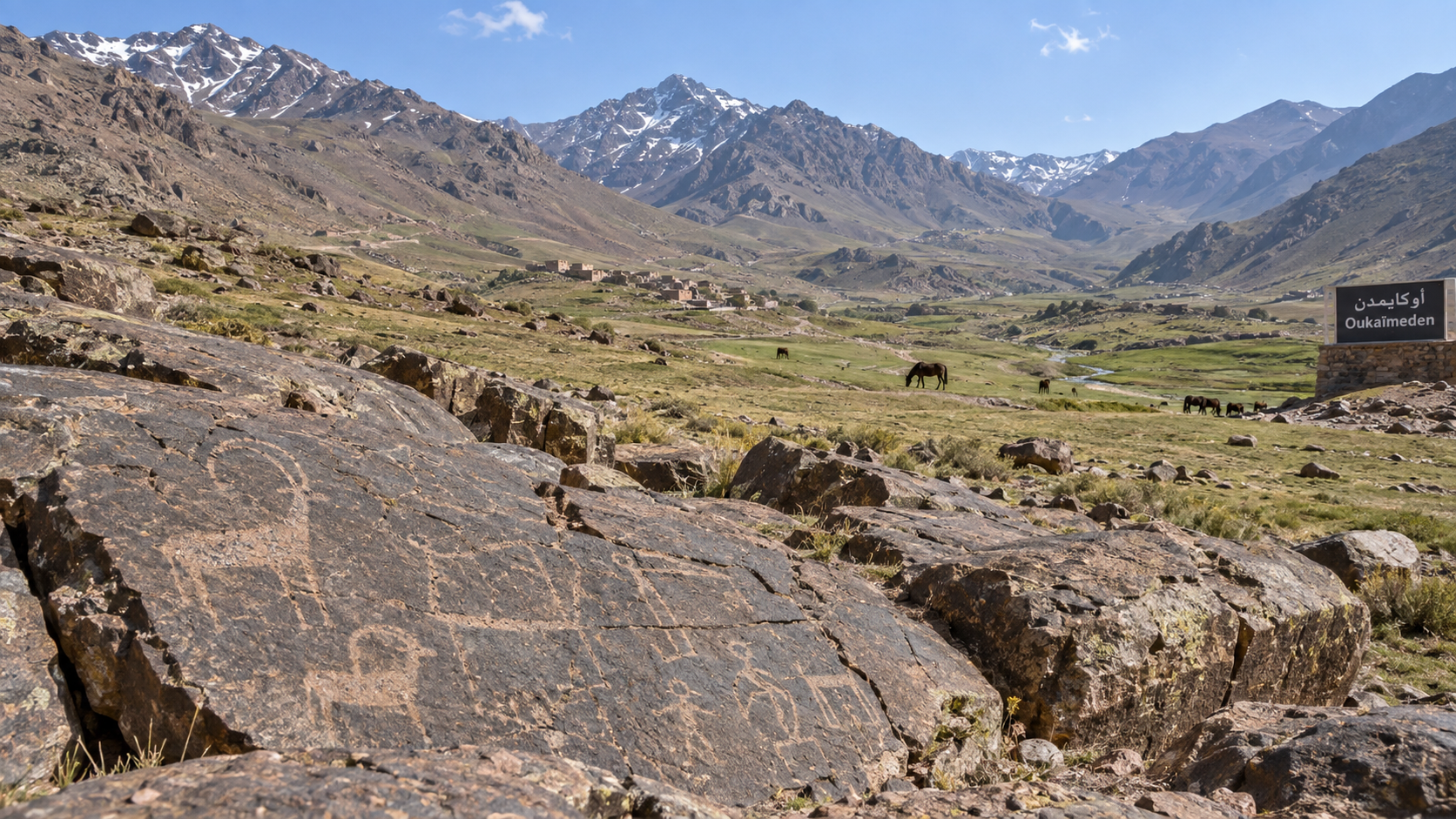
Today, Oukaïmeden is widely known as a mountain destination south of Marrakech.
Visitors come for its high-altitude scenery and, during suitable winter conditions, skiing.
But long before modern tourism arrived, people were using this valley and leaving images on its rocks.
Located at about 2,630 meters above sea level, Oukaïmeden contains one of Morocco’s most remarkable concentrations of prehistoric engravings.
The British Museum’s African Rock Art archive records approximately 250 rock art sites and around one thousand depictions within the Oukaïmeden valley itself.
These are not all simple animal carvings.
The High Atlas engravings include some subjects that make Oukaïmeden particularly distinctive.
Weapons Carved Into Stone
Weapons are among the most characteristic elements of Oukaïmeden rock art.
Engraved daggers, halberd-like weapons, and other forms appear on rock surfaces, sometimes isolated and sometimes associated with human figures.
Researchers have compared some of these representations with archaeological weapon types and have proposed Bronze Age dates for certain examples.
This relationship between rock art and recognizable objects is especially useful because dating prehistoric engravings is normally difficult.
Human Figures
Oukaïmeden also contains unusual anthropomorphic figures.
Some are large frontal representations associated with weapons and other symbols.
Unlike a photograph, however, these images should not automatically be interpreted literally.
Rock art can express identity, ritual, status, memory, storytelling, or symbolic ideas that are difficult to reconstruct thousands of years later.
Geometric Forms and Possible Shields
Circular designs are particularly common in parts of the valley.
Some have complex internal patterns.
They have often been interpreted as shields, although other explanations have also been suggested.
This uncertainty is important.
One of the mistakes visitors can make when looking at prehistoric art is assuming every symbol has a simple modern explanation.
Sometimes the most accurate answer is that its meaning remains unknown.
Elephants in the High Atlas
Perhaps one of the most surprising subjects at Oukaïmeden is the elephant.
An engraving known as the Elephants’ Frieze includes several elephant figures along with other animals.
Finding elephants represented at more than 2,000 meters in today’s High Atlas immediately raises interesting questions.
Were the artists depicting animals they knew directly?
Were the images created during different climatic conditions?
Did the animals have symbolic importance?
The engravings do not provide easy answers, but they demonstrate how different the human and environmental history of Morocco can be from the landscape we see today.
Readers interested in discovering how Morocco’s mountains preserve much older natural history can also explore Atlas Geo Tours’ geological tours across Morocco.
Yagour Plateau and the High Atlas Rock Art Landscape
Oukaïmeden is not isolated.
The Yagour Plateau is another major High Atlas rock art zone, forming part of a broader archaeological landscape that includes thousands of engravings.
The plateau’s seasonal pastures help explain why people repeatedly moved through these high-altitude areas.
Pastoral communities could bring livestock into mountain zones during warmer months when grazing conditions were favorable.
This movement created long-term relationships between people and particular valleys, water sources, passes, and grazing grounds.
Rock art may have formed part of those relationships.
Some engravings could have marked important places.
Others may have carried symbolic or ritual meaning.
Some could simply reflect activities, animals, or objects familiar to the people creating them.
The challenge is that prehistoric artists did not leave explanations beside their images.
Archaeologists therefore study style, weathering, superimposition, associated artifacts, and comparisons with known objects in order to reconstruct possible chronological sequences.
Southern Morocco and the Draa Valley Rock Art
South of the High Atlas, the character of the landscape changes.
Mountain valleys gradually open toward dry plateaus, oases, and Saharan environments.
The rock art changes too.
The broader Draa region contains one of Morocco’s largest concentrations of engraved sites.
At least 120 rock art sites have been documented along the Draa Valley and surrounding areas, according to records in the British Museum collection.
The images found here include wild animals, cattle, horses, camels, riders, and geometric or unidentified forms.
This variety reflects an extraordinarily long period of environmental and cultural change.
Atlas Geo Tours already crosses the Draa region on several desert and geological journeys, including routes that travel from Ouarzazate through the valley toward southern Morocco. Travelers interested in experiencing this wider landscape can discover the 4-day Sahara journey from Agadir, which passes through the Draa Valley on the way toward the desert.
Aït Ouazik and the Rock Art of the Draa Region
One particularly important area is Aït Ouazik, known for its engraved rock surfaces.
The subjects found in southern Morocco can be very different from those of the High Atlas.
Wild animals represented in the region include creatures associated with environments much less arid than today’s desert.
Researchers have documented figures interpreted as ostriches, lions, rhinoceroses, and other animals, together with cattle and later images involving horses and camels.
These engravings effectively create layers of time on the same landscape.
One rock surface may contain images from different periods.
Later artists sometimes added new engravings beside, or even over, older images.
In certain cases, an existing shape was modified and transformed into something else.
This makes rock art almost like a book that was repeatedly rewritten over centuries or millennia.
What Do Morocco’s Rock Engravings Show?
The subjects preserved in Sahara rock art Morocco are extraordinarily varied.
Certain themes appear repeatedly.
Wild Animals
Animals are among the most important subjects.
Engravings can include species that are now absent from the areas where they were represented.
These images are valuable, but they must be interpreted carefully. An animal engraving does not provide a direct climate measurement or prove that the animal lived at that exact location at that exact moment.
Still, when rock art is studied alongside archaeology, fossils, sediments, and paleoclimate evidence, it can contribute to a much broader understanding of ancient North African environments.
Cattle
Cattle are particularly important in Saharan rock art traditions.
Their appearance is associated with periods when pastoralism became central to many communities.
Cattle images provide clues about the changing relationship between people, domesticated animals, and landscapes.
They also show that parts of North Africa once supported pastoral ways of life that would be difficult in today’s most arid environments.
Horses and Riders
Later engravings introduce horses and mounted figures.
These images represent another major change in mobility.
Horses transformed movement, communication, warfare, and social organization in many parts of North Africa.
Camels
Camels appear in later phases of Saharan rock art.
Their presence reflects the growing importance of an animal exceptionally adapted to arid travel.
Camel transport would eventually become fundamental to long-distance movement and trade across Saharan landscapes.
Weapons
Weapons are especially prominent in High Atlas art.
Daggers, halberd-like objects, and other forms appear repeatedly.
Because some can be compared with archaeologically known weapon types, they have played an important role in discussions about chronology.
Geometric Symbols
Not everything can be identified.
Circles, lines, grids, and unusual geometric forms appear throughout Moroccan rock art.
Some have proposed interpretations.
Others remain mysterious.
This uncertainty is one of the most fascinating parts of studying ancient engravings. We can see exactly what was carved, but understanding what the symbol meant to its creator is another problem entirely.
Discover Morocco’s Geological Treasures
Explore the Sahara, fossils, minerals, and unique geological landscapes with an expert-led journey.
How Old Is Prehistoric Rock Art in Morocco?
This apparently simple question has a complicated answer.
Rock engravings are notoriously difficult to date directly.
Unlike an organic object that may be suitable for radiocarbon dating, a line carved into a rock surface does not automatically contain datable material.
Researchers therefore rely on several approaches.
Style
Certain artistic styles appear to belong to particular periods or cultural traditions.
Comparisons between sites can help build relative chronologies.
Superimposition
Sometimes one engraving is carved over another.
The lower engraving must logically be older than the one above it.
A large number of such relationships can help researchers establish sequences.
Weathering and Patina
Older engravings may develop surfaces that resemble the surrounding rock more closely as they weather.
However, environmental conditions vary, making this technique unreliable when used alone.
Objects Shown in the Art
Weapons, horses, camels, and other recognizable subjects can provide chronological clues.
If an engraving depicts a type of weapon known archaeologically from a particular period, researchers may compare the two.
For this reason, it is better to think of prehistoric rock art in Morocco as a long and complex tradition rather than artwork created during one single period.
Some images are truly prehistoric.
Others belong to later historical phases.
Together they document repeated human engagement with the same landscapes.
What Are the Main Rock Art Traditions in Southern Morocco?
Researchers studying southern Moroccan and Saharan art often discuss several broad traditions.
These categories are useful, although real archaeological sequences can be more complicated than a simple timeline suggests.
Tazina Tradition
Tazina-style engravings are known across parts of North Africa.
Animals can appear with elegantly elongated bodies and limbs.
This distinctive style is one of the recognizable traditions of Saharan engraving.
Cattle or Pastoral Tradition
Cattle became central to later rock art.
These scenes relate to societies for whom herding played an increasingly important role.
Horse and Libyco-Berber Traditions
Later engravings include horses, riders, weapons, and inscriptions.
Libyco-Berber writing is particularly interesting because it links images with early forms of writing found across North Africa.
Camel Period
Camel imagery belongs to still later phases and reflects increasingly arid conditions and changing patterns of desert mobility.
The transitions between these traditions should not be treated as perfectly sharp borders.
Different cultural practices may overlap, and dating remains an active area of archaeological research.
Rock Art and a Changing Sahara
One of the most interesting things about Moroccan rock art is the landscape surrounding it.
Today, many southern sites lie in extremely dry environments.
Yet ancient images sometimes depict animals and pastoral scenes associated with very different ecological conditions.
North Africa experienced major climatic fluctuations throughout prehistory.
There were periods when areas now dominated by desert supported more grassland, lakes, rivers, and wildlife.
As conditions changed, people adapted.
Hunting strategies changed.
Pastoralism expanded.
Routes shifted.
Eventually, animals such as camels became increasingly important for moving through dry landscapes.
Rock art cannot tell this entire story by itself.
But it gives us human images that can be considered alongside geological and environmental evidence.
This connection between people and changing landscapes is one reason archaeology fits naturally with the geological experiences offered by Atlas Geo Tours.
A desert valley is never only a modern landscape.
Its rocks may preserve fossils from an ancient sea.
Its sediments may record changing climates.
Its cliffs may contain engravings made by prehistoric communities.
And its routes may still connect villages, oases, and mountains today.
How Were the Engravings Made?
Creating a petroglyph required time and effort.
Artists did not have modern metal engraving equipment.
Several techniques could be used depending on the period, available tools, and desired result.
Pecking
A harder stone was repeatedly struck against the rock surface.
Thousands of impacts gradually created lines or filled areas.
Incising
A sharp tool could scratch or cut a line into the surface.
Grinding and Polishing
Some figures were created or finished by rubbing and polishing the stone.
Different techniques can sometimes be visible within the same site.
For archaeologists, these details may offer clues about the sequence in which images were produced.
For visitors, looking closely at the marks also makes the human effort much easier to appreciate.
These were not naturally occurring patterns.
Someone intentionally created them.
Can You Visit Morocco Rock Art Sites?
Yes, some Morocco rock art sites can be visited, but they should be approached differently from ordinary tourist attractions.
Many are located in open landscapes rather than museums or controlled archaeological parks.
This means visitors have a responsibility to protect them.
Remote sites may also require local knowledge because engravings can be difficult to locate even when you know they exist.
A rock surface that looks ordinary from a distance may reveal dozens of figures once you approach it from the correct direction and light.
Visit With Local Knowledge
A knowledgeable guide can help identify genuine engravings, explain the landscape, and avoid unnecessary disturbance.
This is particularly valuable in remote southern areas where tracks and sites may not be obvious.
Morning and Late Afternoon Light Can Help
Low-angle sunlight creates shadows within shallow carved lines.
This can make engravings much easier to see and photograph.
At midday, flat overhead lighting may make subtle designs almost disappear.
Never Trace or Enhance the Engravings
Do not use chalk, water, paint, or other substances to make carvings more visible.
Do not scratch existing lines.
Do not attempt to make rubbings unless this is part of authorized scientific work.
Never Remove Pieces
Rock art belongs to the site and landscape where it was created.
Removing engraved stone destroys its archaeological context and permanently damages the heritage.
Photographing Rock Art Responsibly
Photography is one of the best ways to preserve a personal memory without physically interfering with the site.
A few simple choices can improve results.
Use side lighting when possible.
Include wider landscape photographs as well as close details.
Avoid standing directly on engraved surfaces.
A scale can be useful in scientific documentation, but casual visitors generally do not need to place objects directly beside carvings.
Most importantly, resist the temptation to touch the engravings repeatedly.
Thousands of visitors touching the same surface can eventually cause real damage.
Combining Archaeology With a Journey Through Southern Morocco
Rock art rarely exists in isolation from the wider landscape.
The Draa Valley, for example, is also a region of palm oases, traditional settlements, geological formations, desert routes, and fossil-bearing areas farther east.
A journey through southern Morocco can therefore reveal several different layers of history.
Travelers may cross the High Atlas, descend toward Ouarzazate, follow the Draa Valley through Agdz and Zagora, and continue toward increasingly arid Saharan environments.
Atlas Geo Tours’ multiday journeys through Morocco provide opportunities to explore these transitions across mountains, valleys, desert landscapes, and cultural sites.
For travelers primarily interested in geology, the Draa Valley also appears within specialized fossil and mineral itineraries such as the 8-day fossils and minerals collecting tour.
This is what makes Morocco especially interesting for curious travelers.
Archaeology, geology, natural history, and modern culture are often present within the same journey.
Why Morocco’s Rock Art Matters
A prehistoric engraving can look simple.
A few lines form an animal.
A circle may represent a shield.
A human figure stands beside a weapon.
Yet those marks have survived while generations of people, climates, and landscapes changed around them.
They are among the few direct visual expressions left by ancient communities who did not leave written histories in the modern sense.
The engravings show what people chose to represent.
Sometimes those choices seem familiar.
Animals.
Weapons.
People.
Movement.
At other times, they remain mysterious.
Geometric signs and unidentified forms remind us that ancient societies understood the world through ideas that may no longer be accessible to us.
That combination of recognition and mystery gives prehistoric rock art in Morocco its power.
The High Atlas preserves an extraordinary mountain tradition around Oukaïmeden, Yagour, and Jbel Rat.
Southern Morocco contains a different but equally important world of Saharan engravings, including large concentrations around the Draa Valley.
Together, they reveal that Morocco’s landscapes are not simply beautiful places to cross.
They are cultural archives.
Every engraving belongs to a specific rock, setting, and view.
Protecting that relationship is essential.
When visitors experience these sites responsibly, the stone remains where its creator placed the image thousands of years ago, allowing future generations to stand in the same landscape and ask the same fascinating question:
What did this image mean to the person who carved it?
Frequently Asked Questions About Prehistoric Rock Art in Morocco
Where can you see prehistoric rock art in Morocco?
Important areas include Oukaïmeden, the Yagour Plateau, and Jbel Rat in the High Atlas, as well as numerous sites throughout southern Morocco and the Draa Valley.
What is Oukaïmeden famous for besides skiing?
Oukaïmeden contains one of Morocco’s most important High Atlas rock art concentrations. The valley includes hundreds of documented sites with engravings of humans, weapons, animals, and geometric symbols.
How many rock art sites are there in Oukaïmeden?
The British Museum’s African Rock Art archive reports around 250 rock art sites and approximately one thousand individual depictions within the Oukaïmeden valley.
What animals appear in Moroccan rock art?
Engravings can include cattle, horses, camels, ostriches, elephants, and other wild animals. The species and styles differ according to region and period.
Are there elephants in Oukaïmeden rock art?
Yes. Elephant representations are documented in Oukaïmeden, including a well-known group often referred to as the Elephants’ Frieze.
What are Morocco petroglyphs?
Petroglyphs are images created by engraving, pecking, cutting, or polishing natural rock surfaces. Most surviving Moroccan rock art consists of these engravings rather than paintings.
How old is Morocco's prehistoric rock art?
There is no single age for all Moroccan rock art. The engravings were created during different periods, and many are difficult to date precisely. Researchers use style, superimposition, weathering, and recognizable objects such as weapons, horses, or camels to establish approximate chronologies.