
Total Solar Eclipse Morocco 2027: The Best Places to Experience Totality
On the morning of August 2, 2027, the sky above northern Morocco will become the stage for one of nature’s most extraordinary astronomical events.
For a few unforgettable minutes, the Moon will pass directly between Earth and the Sun. In the narrow region known as the path of totality, the bright surface of the Sun will disappear completely, daylight will fade, and the delicate solar corona will become visible around the dark silhouette of the Moon.
The solar eclipse Morocco 2027 will attract astronomy enthusiasts, photographers, travelers, families, and eclipse chasers from around the world. Northern Morocco is especially interesting because several destinations will experience more than four minutes of totality, while offering very different landscapes, from the Strait of Gibraltar and Mediterranean coast to the Rif Mountains.
Current eclipse calculations show that Tangier will experience about 4 minutes and 51 seconds of totality, with maximum eclipse around 8:47 a.m. on August 2, 2027. Across Morocco, totality begins in the north at around 8:44 a.m. and leaves the country several minutes later.
But seeing a total eclipse successfully requires more than simply traveling north.
You need to understand the path of totality, choose a suitable observation location, watch the weather, prepare the right equipment, and protect your eyes during the partial phases.
If you are planning to experience the total solar eclipse Morocco 2027, this guide will help you understand where to go, what to expect, and how to prepare for one of the most remarkable mornings Morocco will experience in 2027.
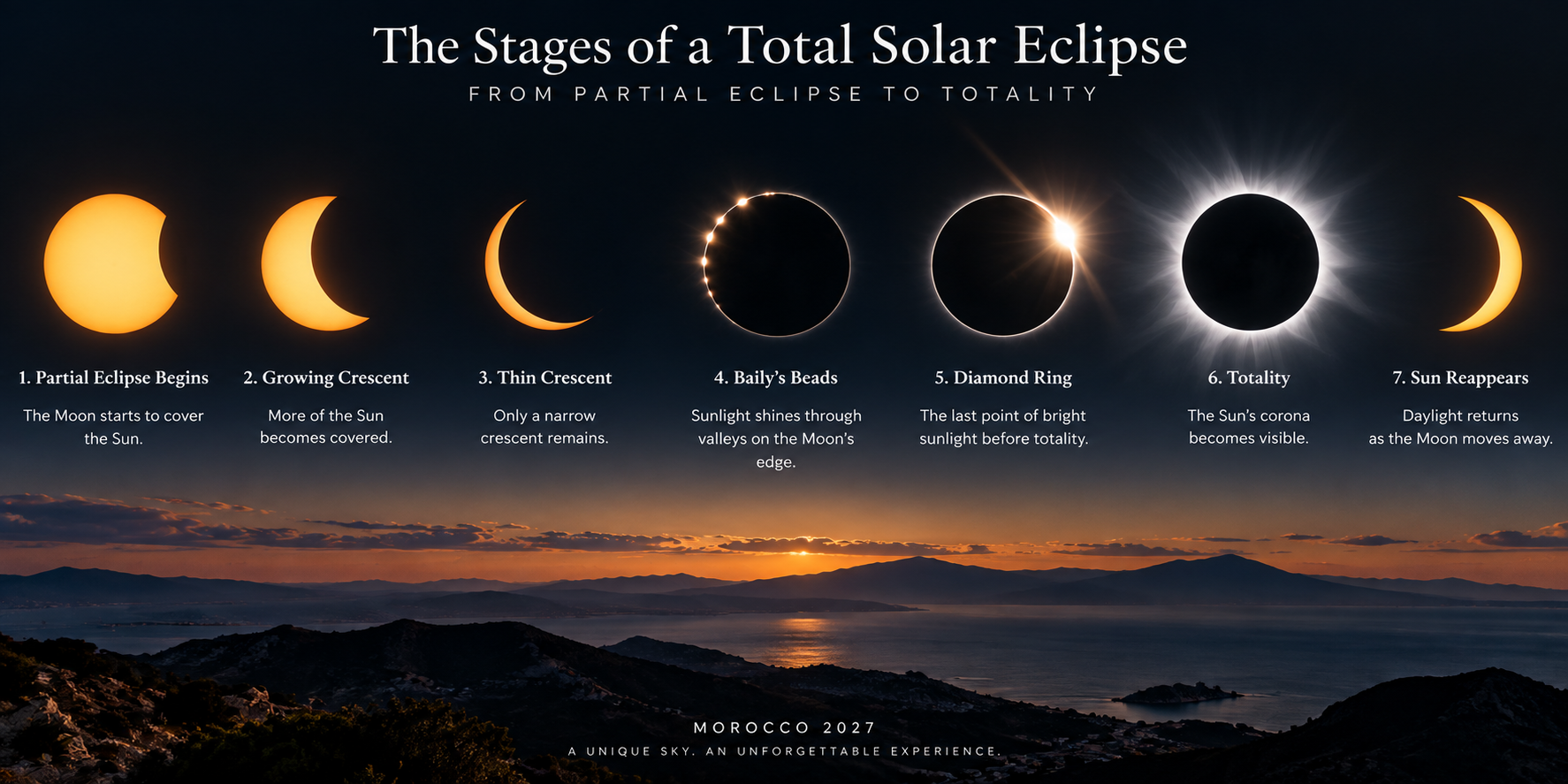
What Is a Total Solar Eclipse?
Why the August 2, 2027 Eclipse Is Exceptional
Not every total solar eclipse lasts the same amount of time.
Some locations experience only seconds of totality. Others may receive one or two minutes.
The 2027 eclipse is especially interesting because northern Morocco lies inside a part of the eclipse path where totality lasts for several minutes.
Tangier, for example, is expected to receive nearly five minutes of complete totality.
That gives observers enough time to look at the corona, notice changes in the surrounding landscape, observe bright objects in the sky, and experience the unusual atmosphere without everything ending almost immediately.
The eclipse will also occur in the morning.
The partial phase begins first, followed by totality later in the morning, before the Moon slowly moves away from the Sun.
For travelers, this means eclipse observation can become the beginning of a much wider day or even a longer journey through northern Morocco.
Where Will the Total Solar Eclipse Be Visible in Morocco?
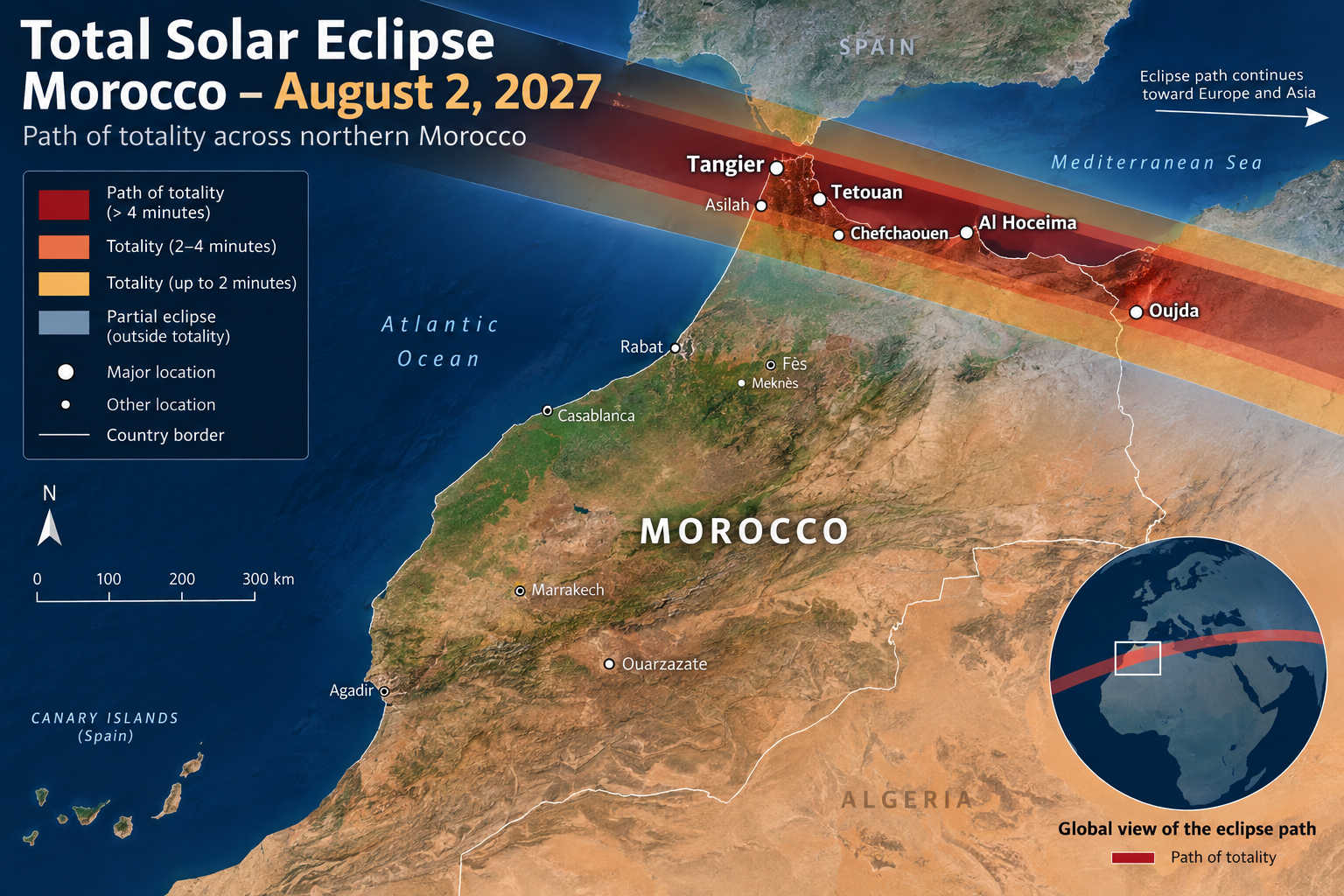
The Morocco eclipse August 2 2027 will not be total across the entire country.
The path of totality crosses northern Morocco.
People in many other parts of the country will still see an impressive partial eclipse, but they will not experience complete darkness or see the solar corona in the same way.
This difference is important.
A partial eclipse with most of the Sun covered can still be spectacular, but the experience changes completely when the final bright part of the Sun disappears.
Travelers who want to experience true totality should therefore position themselves inside the northern totality zone.
Some of the most interesting 2027 eclipse Morocco viewing locations include:
- Tangier
- Tetouan
- Asilah
- Chefchaouen
- Al Hoceima
- parts of the Rif Mountains
- areas farther east toward Oujda
The duration changes depending on your exact position inside the eclipse path.
In general, places closer to the center of the path receive longer totality.
Tangier: One of the Best Places to See the Eclipse in Morocco
Tangier will probably be one of the most popular destinations for the solar eclipse Morocco 2027.
The reason is easy to understand.
Current calculations indicate approximately 4 minutes and 51 seconds of totality in Tangier. The partial eclipse begins around 7:40 a.m., maximum eclipse occurs around 8:47 a.m., and the complete event ends around 10:00 a.m.
For eclipse travelers, this is an excellent duration.
Tangier also offers practical advantages.
It is one of the largest cities in northern Morocco and has extensive accommodation, restaurants, road connections, transport services, and international access.
Visitors can stay in the city and travel to a quieter area outside the center on eclipse morning.
Why Tangier Is Attractive for Eclipse Travelers
Tangier combines astronomy with landscape.
The surrounding region includes:
- Atlantic coastline
- views toward the Strait of Gibraltar
- open countryside
- rolling hills
- coastal viewpoints
- rural areas outside the city
For photographers, these landscapes provide opportunities to create a more memorable composition than simply photographing the Sun alone.
However, one factor must remain a priority: weather.
A beautiful viewpoint is useless if clouds cover the Sun during totality.
For this reason, visitors should identify several possible observation locations instead of relying on only one site.
Tetouan: Long Totality Near the Rif Mountains
Tetouan is another excellent choice.
Its position in northern Morocco places it very well within the totality corridor, with eclipse durations very similar to Tangier.
Tetouan also offers a different environment.
The city sits between Mediterranean landscapes and the Rif Mountains, giving travelers opportunities to combine astronomy with history, architecture, mountains, and northern Moroccan culture.
The countryside surrounding Tetouan can also provide open areas away from buildings.
This is important because an eclipse observation point should ideally have a clear view of the morning sky.
For travelers asking for the best place to see eclipse Morocco, Tetouan deserves to be considered alongside Tangier rather than treated as a secondary option.
Asilah: Totality on Morocco’s Atlantic Coast
Asilah lies south of Tangier on the Atlantic coast.
It is smaller and quieter than Tangier, making it attractive to travelers who prefer a less urban experience.
Current eclipse calculations show that locations around this part of northern Morocco remain well inside the totality zone, with several minutes of complete coverage.
Asilah also offers open coastal landscapes.
A carefully chosen observation location outside the town could provide wide views of the sky while keeping buildings and other obstructions away from the horizon.
The main concern is again coastal weather.
Marine cloud and haze can occasionally affect Atlantic areas, so the final decision should depend on short-term forecasts rather than scenery alone.
Chefchaouen: Watching Totality From the Rif Mountains
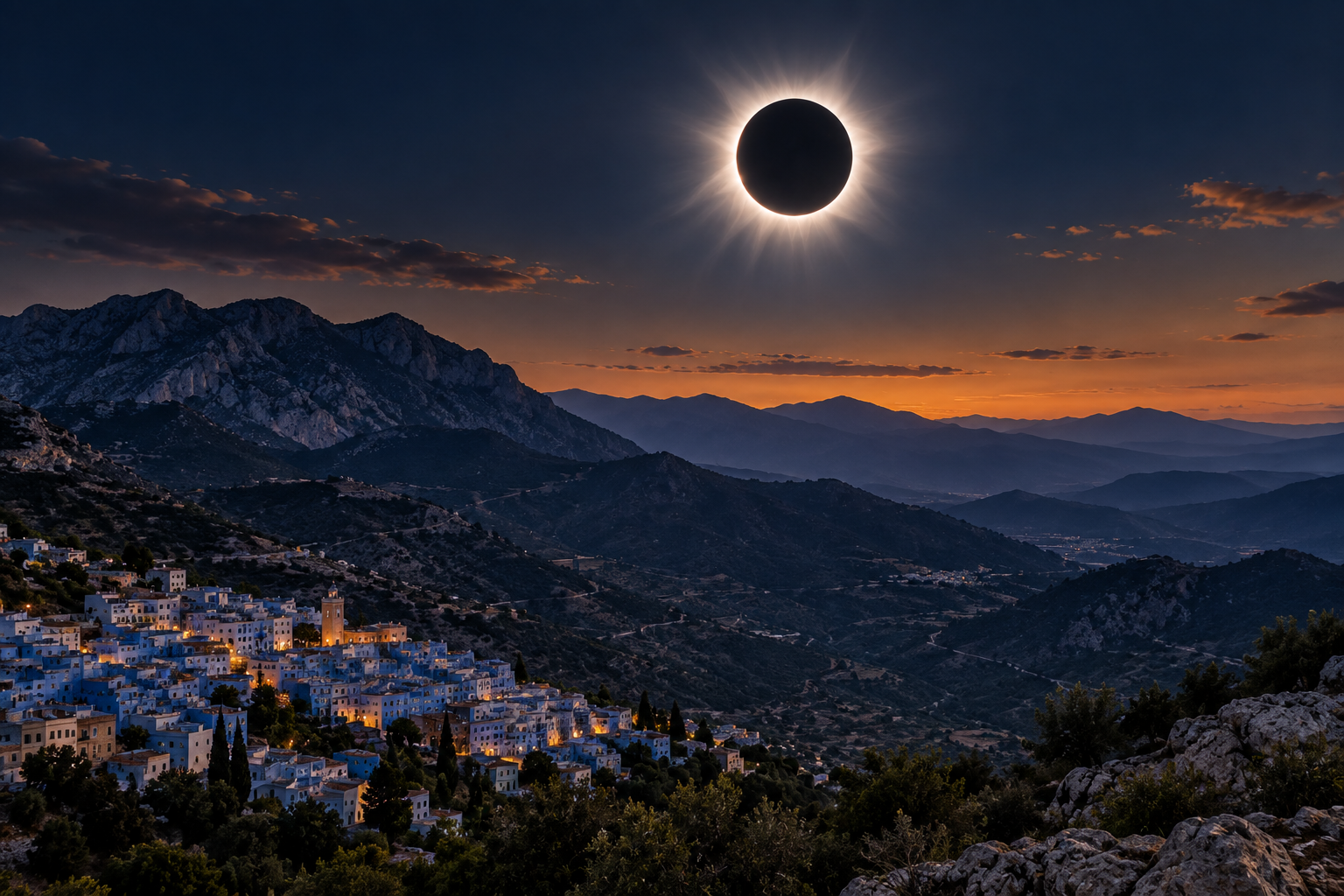
Chefchaouen offers one of the most visually distinctive eclipse settings in Morocco.
The blue city sits among the Rif Mountains, surrounded by dramatic ridges and valleys.
Experiencing morning darkness beneath these mountains could make the Morocco totality 2027 particularly memorable.
But mountain observation requires planning.
A viewpoint may look spectacular while still providing a poor view of the Sun.
Because the eclipse happens in the morning, surrounding ridges can block parts of the eastern or southeastern sky depending on your exact location.
For this reason, visitors should inspect possible observation points beforehand.
Look for a location with:
- a wide open horizon
- limited obstruction from nearby peaks
- easy road access
- enough space for equipment
- safe parking
- an alternative site nearby
The goal should be to combine scenery with practical astronomy.
Al Hoceima: Mediterranean Scenery Under the Moon’s Shadow
Al Hoceima offers another attractive eclipse option.
Located on Morocco’s Mediterranean coast, the region combines mountains, cliffs, beaches, and protected natural landscapes.
Several areas around Al Hoceima fall inside the path of totality.
This makes the region especially interesting for travelers who want to avoid the most obvious western viewing locations while still experiencing several minutes of complete eclipse.
Another advantage is geographical flexibility.
If forecasts show poor weather near Tangier or Tetouan, travelers with transport may decide to move farther east along the eclipse corridor.
Experienced eclipse observers often value this flexibility.
A slightly shorter total eclipse under a clear sky is far better than a longer eclipse hidden behind clouds.
Oujda: A Shorter Eclipse but Potentially Useful Alternative
Oujda lies much closer to the edge of the totality zone.
Current calculations show totality there lasting just over one minute, considerably shorter than around Tangier.
For someone planning their first total eclipse, Tangier, Tetouan, or other locations deeper inside the path may be preferable.
However, Oujda can still become important if weather conditions are much better in eastern Morocco.
This is one reason a flexible eclipse plan is often better than choosing a single viewing location months in advance and refusing to change it.
How to Choose the Best Eclipse Viewing Location
There is no single answer to the question of where to watch the eclipse.
Several factors need to be considered together.
Totality Duration
Longer totality gives you more time to observe the corona and experience the darkened landscape.
This gives Tangier and Tetouan a major advantage.
Weather
Weather may ultimately matter more than duration.
Clouds can hide the Sun completely during totality.
Historical cloud statistics can help when comparing regions, but actual weather forecasts become useful only much closer to August 2, 2027. Current eclipse data sources themselves note that real forecasts become available shortly before the event.
Horizon
The Sun will not be directly overhead during the morning eclipse.
Buildings, mountains, trees, or ridges can therefore become important.
Choose a location with a clear view.
Accessibility
Remote locations may offer better horizons but can create other problems.
Consider:
- road conditions
- parking
- travel time
- access after sunrise
- crowd movement
- communication coverage
- availability of water
Mobility
One of the best strategies is to choose accommodation inside the totality zone while keeping access to a vehicle.
Then identify several possible observation sites.
The final location can be selected after checking updated weather forecasts.
What Will Totality Feel Like?
A total solar eclipse is difficult to understand fully until you experience one.
The partial phases are interesting, but totality changes the atmosphere completely.
As the final minutes approach, daylight begins to weaken quickly.
The landscape may develop unusual gray or metallic tones.
Temperatures can fall.
Shadows become strange.
Then the last bright part of the Sun disappears.
For a few minutes, the Moon appears as a completely black circle in the sky.
Around it, the corona becomes visible.
The horizon may still glow with colors similar to sunset because areas outside the Moon’s shadow remain illuminated.
Depending on atmospheric conditions, bright planets and stars may become visible.
Then another brilliant point of sunlight appears.
The diamond-ring effect returns and daylight begins recovering.
The transformation happens remarkably quickly.
This is why a total eclipse feels completely different from simply watching the Sun through solar glasses.
What Are Baily’s Beads and the Diamond Ring?
Some of the most beautiful moments happen immediately before and after totality.
Baily’s Beads
The Moon does not have a perfectly smooth surface.
Mountains, valleys, and craters create an uneven edge.
Just before totality, sunlight can pass through low areas along this edge, creating several bright points.
These points are called Baily’s beads.
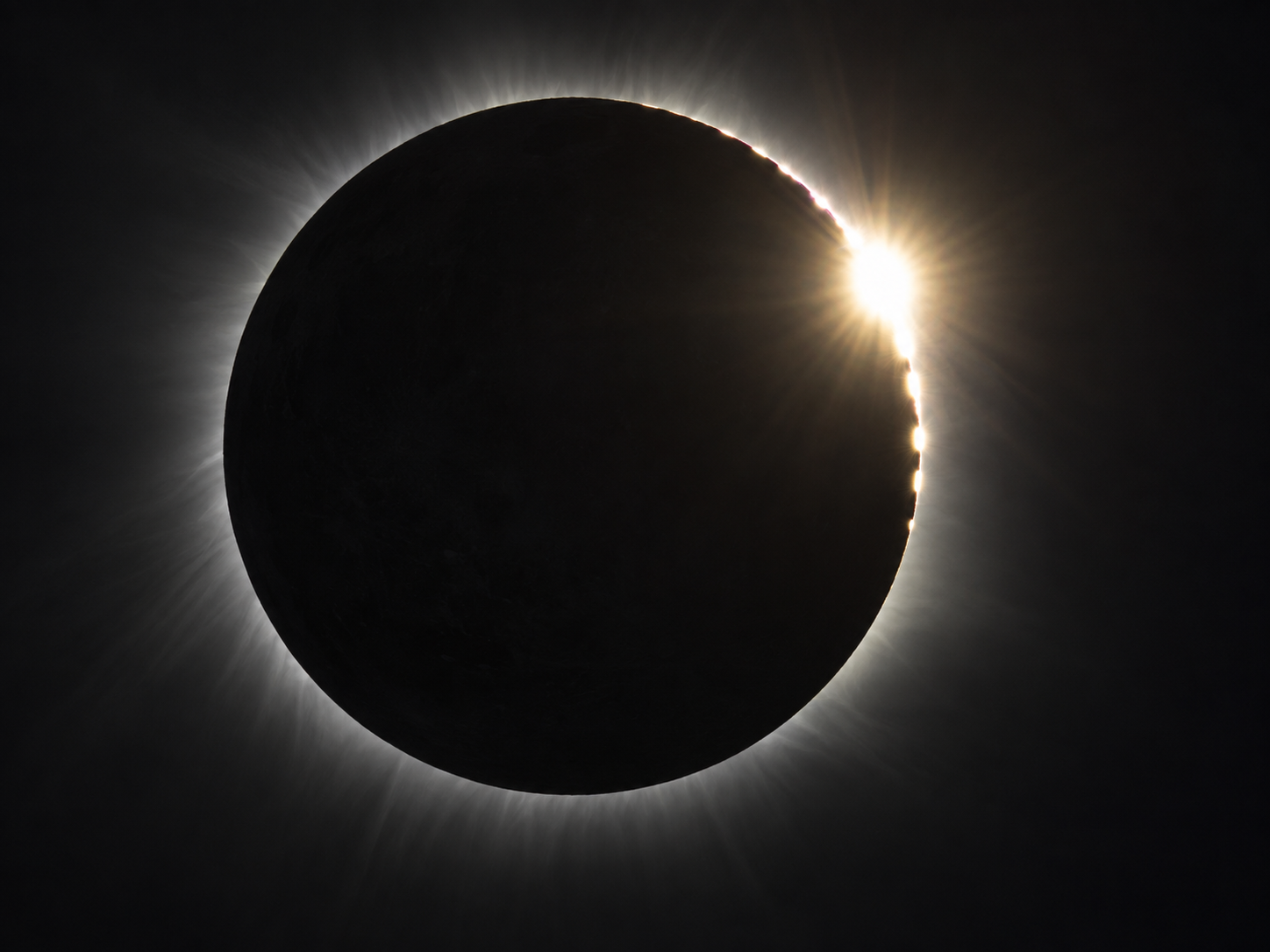
Diamond Ring Effect
As the last intense point of sunlight remains beside the emerging corona, the eclipse can resemble a glowing diamond ring.
This phase lasts only briefly.
Soon afterward, the solar surface becomes completely hidden and totality begins.
These moments are especially popular among eclipse photographers.
Plan Your Morocco Eclipse Adventure
Experience the Solar Eclipse Morocco 2027 and discover more of Morocco along the way.
How to Watch the 2027 Solar Eclipse Safely
Eye safety is essential during a solar eclipse.
During the partial phases, looking directly at the Sun without suitable solar protection can cause serious eye damage.
Regular sunglasses are not sufficient.
Use certified solar eclipse glasses or another safe solar viewer intended specifically for direct observation of the Sun.
Cameras, binoculars, and telescopes also require properly designed solar filters whenever the bright surface of the Sun is visible.
Never look through binoculars or a telescope while wearing only eclipse glasses.
Magnified sunlight can damage the glasses and your eyes.
When Can Eclipse Glasses Be Removed?
There is one exception.
Observers located inside the path of totality can remove their solar glasses during the brief period when the Moon completely covers the bright surface of the Sun.
As soon as bright sunlight begins to return, eye protection must be used again.
If you are uncertain whether complete totality has begun, keep the glasses on.
What Should You Bring for the Eclipse?
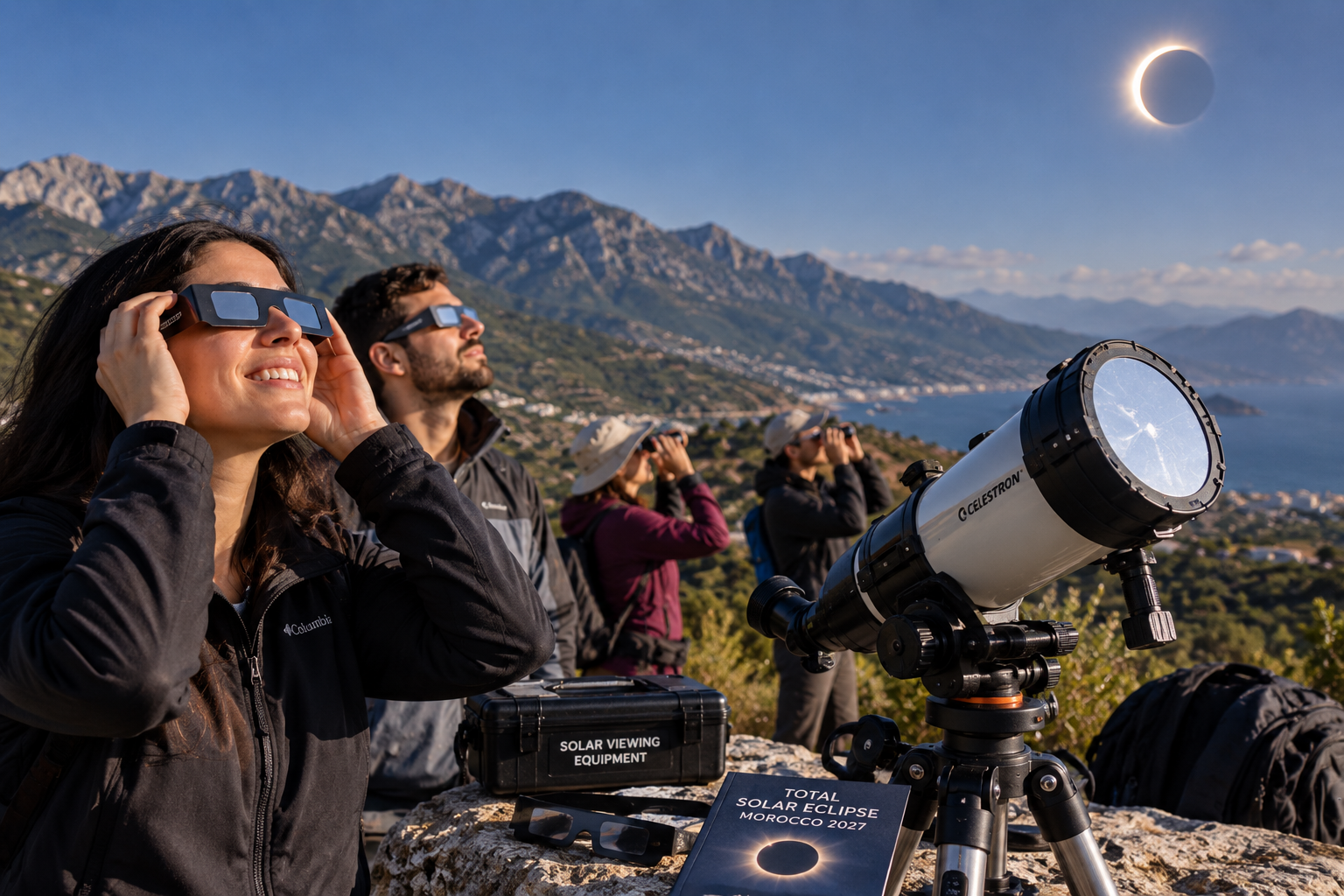
You do not need complicated equipment to enjoy the event.
For most observers, good preparation is more important than expensive technology.
Consider bringing:
- certified eclipse glasses
- one or two spare pairs
- water
- hat
- sunscreen
- comfortable clothing
- small chair
- binoculars only with correct solar filters
- camera equipment if desired
- tripod
- power bank
- offline map
- exact eclipse timing information
- snacks or breakfast
The complete eclipse event lasts much longer than the few minutes of totality.
You may spend several hours outside from the beginning of the partial phase until the Sun returns completely.
August can also be warm in Morocco, so water and sun protection remain essential.
Photographing the Solar Eclipse in Morocco
Morocco offers excellent possibilities for eclipse photography because the astronomical event can be combined with recognizable landscapes.
Possible foregrounds include:
- Rif Mountain silhouettes
- Atlantic coastal scenery
- Mediterranean cliffs
- traditional northern Moroccan architecture
- open countryside
Photographers should practice before the event.
Do not wait until eclipse morning to learn how to operate your equipment.
During the partial phases, cameras and telephoto lenses require suitable solar filters.
During totality, photographers can remove the solar filter and use different exposure settings to photograph the corona.
As soon as the bright Sun reappears, the filter must return.
Most importantly, remember that the event is not only about photography.
Totality lasts only minutes.
Spend at least part of that time looking directly at the eclipsed Sun rather than watching everything through a camera display.
Combine the Eclipse With Stargazing in Morocco
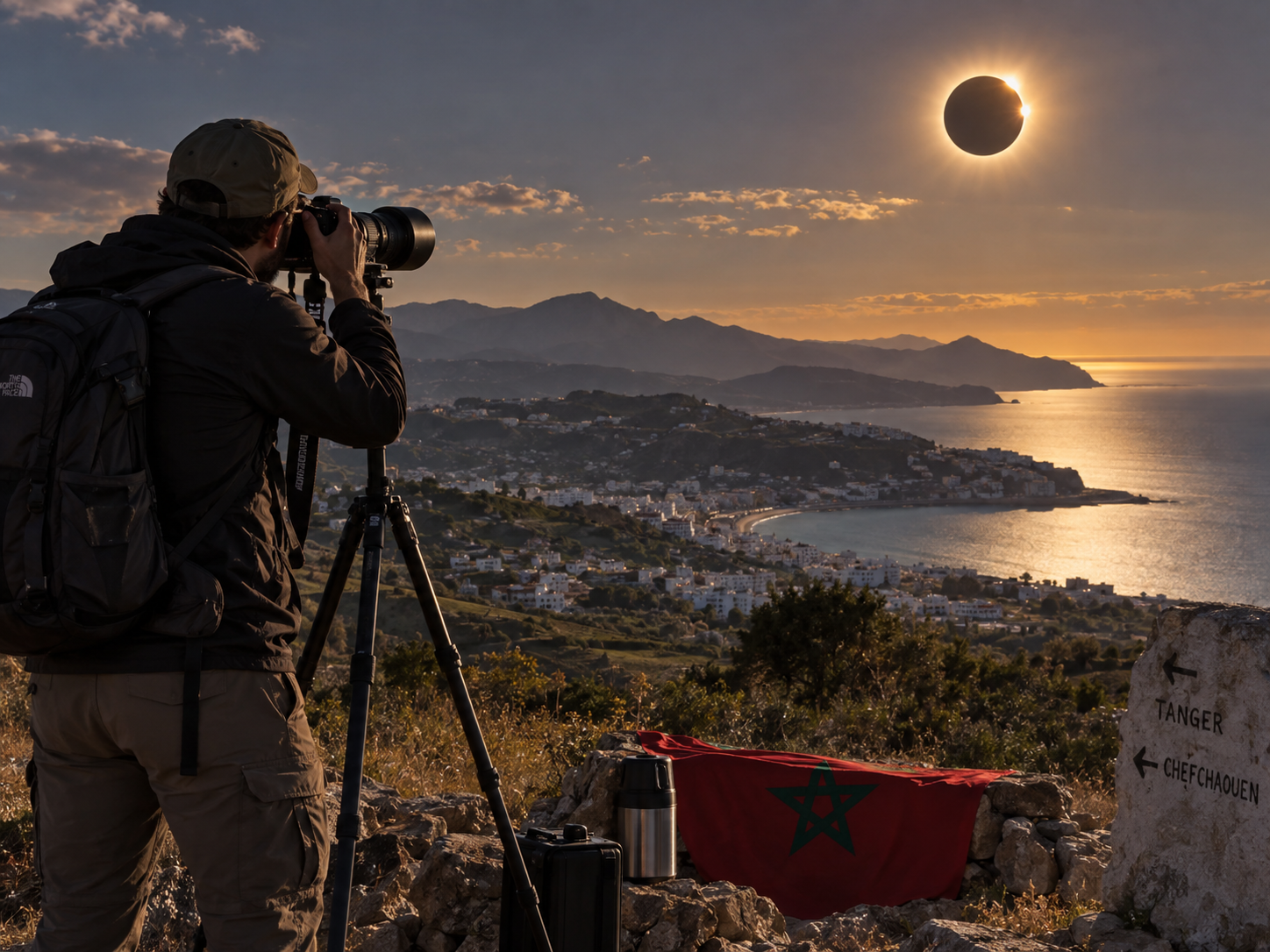
The eclipse lasts only one morning, but Morocco offers much more for travelers interested in astronomy.
After experiencing totality in the north, visitors can continue toward the Atlas Mountains and Sahara, where darker skies provide excellent opportunities for nighttime observation.
Atlas Geo Tours organizes stargazing tours in Morocco for travelers interested in planets, constellations, stars, and deep-sky objects.
The difference between the eclipse and a desert astronomy experience is fascinating.
During the eclipse, travelers observe the Moon blocking the Sun during daylight.
At night in the Sahara, they can observe the wider universe against much darker skies.
For travelers interested in both Earth and space sciences, Atlas Geo Tours also offers a 5-day astronomy and geology field trip.
This journey combines astronomy with Morocco’s geological landscapes, fossil areas, mountains, and desert environments.
The 2027 eclipse can therefore become the starting point for a much larger scientific journey through Morocco.
Why Morocco Is Perfect for Astronomy Travel
Morocco offers unusual geographical diversity within one country.
A traveler can begin near the Mediterranean or Atlantic coast, cross mountain ranges, continue through ancient geological formations, and reach the Sahara within the same trip.
These landscapes also create different astronomy environments.
Northern Morocco will be the place to experience totality in 2027.
Southern Morocco offers some of the country’s most impressive dark-sky environments.
For readers interested in Morocco’s night sky beyond the eclipse, Atlas Geo Tours’ existing guide to astronomy and geology travel in Morocco explores how these two sciences can be experienced together during a journey across the country.
This connection between geology and astronomy is particularly natural in Morocco.
During the day, visitors can read hundreds of millions of years of Earth history in mountains, rocks, fossils, and desert formations.
At night, they can look beyond Earth toward planets, stars, and galaxies.
Plan Early but Remain Flexible
The Morocco eclipse August 2 2027 is likely to attract growing international attention as the date approaches.
Accommodation in northern destinations may become increasingly difficult to find.
Travelers interested in Tangier, Tetouan, Chefchaouen, Asilah, or Al Hoceima should consider arranging accommodation and transportation well in advance.
However, do not make your eclipse plan too rigid.
The exact observation site should remain flexible until weather forecasts become reliable.
A practical approach is to:
- Choose accommodation well inside the totality region.
- Identify several observation sites.
- Arrange reliable transportation.
- Monitor forecasts in the final days.
- Select the clearest location while remaining inside the path.
Visitors who want to turn the eclipse into a longer Moroccan adventure can also explore Atlas Geo Tours’ multiday tours covering the mountains, desert, geology, culture, and other parts of the country.
Experience Morocco Under the Moon’s Shadow
Most travelers visit Morocco to discover its cities, mountains, deserts, fossils, culture, and landscapes.
On August 2, 2027, northern Morocco will offer something that cannot be experienced there on an ordinary day.
Morning will briefly become twilight.
The bright surface of the Sun will disappear.
The solar corona will stretch around the dark Moon.
Tangier, Tetouan, Asilah, Chefchaouen, Al Hoceima, and other northern locations will all provide different ways to experience the event.
For some travelers, the priority will be totality duration.
Others will search for the perfect landscape.
Photographers may plan months in advance for one composition.
Astronomy enthusiasts may combine the eclipse with several nights of stargazing.
Whatever approach you choose, preparation will make the experience better.
Understand the path of totality. Choose several possible observation sites. Bring proper solar protection. Follow the weather. Arrive early.
And when totality finally begins, take time to experience it.
For a few minutes, Morocco’s landscape and the sky above it will become part of the same extraordinary astronomical event.
Frequently Asked Questions About the Solar Eclipse Morocco 2027
When is the total solar eclipse in Morocco?
The total solar eclipse will occur on August 2, 2027. Northern Morocco lies inside the path of totality, while other regions of the country will experience a partial eclipse.
Where is the best place to see the 2027 eclipse in Morocco?
Tangier and Tetouan are among the strongest choices because they combine long totality with good accommodation and transportation. Asilah, Chefchaouen, and Al Hoceima are also attractive viewing locations.
How long will totality last in Tangier?
Current calculations indicate approximately 4 minutes and 51 seconds of totality in Tangier, with maximum eclipse around 8:47 a.m.
Will the eclipse be total in Chefchaouen?
Yes. Chefchaouen lies inside the northern totality path. Visitors should choose an observation point carefully because surrounding mountains may block part of the morning sky from some locations.
Will Marrakech experience totality?
No. Marrakech lies outside the totality path. Visitors there will still experience a significant partial eclipse, but the Sun will not be completely covered.
Will Casablanca experience a total eclipse?
No. Casablanca will experience a partial solar eclipse. Travelers who want to experience the corona and complete totality should move farther north.
Do I need eclipse glasses?
Yes. Eclipse glasses are required during all partial phases. They can be removed only during complete totality when the bright solar surface is entirely hidden.
Can I photograph the eclipse?
Yes. Cameras require proper solar filters whenever the bright Sun is visible. Photographers should practice their equipment before eclipse day and prepare exposure settings in advance.
What happens if it is cloudy?
Cloud can hide the eclipse completely. Monitor forecasts in the days before August 2 and keep enough transportation flexibility to move toward a clearer location inside the totality path.
Is Tangier better than Tetouan for the eclipse?
Both are excellent choices. Tangier offers strong international accessibility and nearly five minutes of totality. Tetouan provides similarly long totality with a different landscape and easy access to the Rif region. The best final choice may depend on weather.
Can I combine the eclipse with a stargazing tour?
Yes. After observing the eclipse in northern Morocco, travelers can continue toward the Atlas Mountains or Sahara for nighttime astronomy and telescope observation through Atlas Geo Tours’ specialized stargazing and astronomy experiences.
Should I book my eclipse trip early?
Yes. Total solar eclipses create concentrated demand inside a relatively small geographic region. Booking accommodation and transport early is recommended, while keeping the exact viewing location flexible until reliable weather forecasts are available.
Discover the Amazing Alnif Trilobites
For anyone fascinated by fossils and the history of life on Earth, Alnif trilobites offer an extraordinary reason to explore southeastern Morocco. The region’s ancient fossil-bearing formations provide a rare opportunity to discover marine life preserved from geological periods that existed hundreds of millions of years ago.
But the real adventure goes beyond the fossil itself. Walking through Alnif’s desert landscapes, examining ancient rock formations, learning how fossils are identified, and searching for specimens with an experienced geological guide turns the journey into a genuine field experience.
Would you like to explore Morocco’s ancient fossil beds yourself? What prehistoric fossil would you most like to discover in Alnif? Share your answer in the comments!